Smart Agents Have Become Commonplace. Now Enterprises Are Asking, ‘Prove What You Did.’
An agent ran a credit review support task last week. The results looked reasonable. But when the person in charge asked why the agent had reached that particular judgment, no one could retrace the process. The model was smart enough, yet there was no record of which evidence it used, which tools it called, or where it stopped. That gap is exactly what several unrelated news items pointed at today, July 9, 2026, each in its own language.
Today’s news split into two directions
One side was a story about intelligence and compute becoming commodities. China’s Ant Group unveiled a vision AI model that can recognize reflective surfaces like glass and mirrors, sweeping 12 benchmarks, and the striking part was not the performance but the scale. With just 1.1 billion parameters, it outperformed a 7 billion class model. It showed how far efficiency focused strategies have come in an environment where access to Nvidia’s high end GPUs is restricted. The same day, OpenAI and Anthropic competed to lock early stage startups into their own ecosystems by giving away free tokens for their top models, while Qualcomm tried to crack Nvidia’s dominance with a low power data center chip that bypasses HBM altogether. Anthropic also expanded its multichip strategy, splitting workloads across Amazon Trainium, Google TPU, and Nvidia GPUs. Neither the intelligence nor the silicon that runs it is tied to one place anymore.
The other side was quieter, but the direction was clear. IT Chosun published an assessment that read, “AI agents that work on their own, and behavior records decide whether we trust them.” What platform companies like Microsoft and UiPath are racing to strengthen is not bigger models, but observability tools that capture every execution step of an agent as logs, metrics, and traces. It is a move to hold onto the traces an agent leaves behind when it judges and acts for itself, going beyond the simple response logs of the generative AI era.
Intelligence is becoming commonplace, and the bottleneck has moved
Put the two directions side by side and one assumption starts to wobble. We have long believed that a smarter model makes a better agent. But when intelligence gets smaller and cheaper, as in Ant Group’s case, and when even access to the best models becomes easier through free token competitions, intelligence stops being a differentiator. What everyone can use is nobody’s edge.
So the point where enterprises actually hesitate was never the last decimal point on a benchmark table. It was the question of whether they can prove, after the fact, what an autonomously operating agent did and why. Korea’s regulatory situation makes this question heavier still. Under the AI Framework Act that took effect in January 2026, the financial and public sectors must maintain a logging system that allows an agent’s decision making process to be verified after the fact, as part of their regulatory response. A gap in behavior records leads directly to disputes over accountability and audit risk.
It is worth reading, in this context, that Hana Financial Convergence Technology Institute unveiled a financial domain AI model for corporate lending and consultation support on the same day. The reason K bank, Shinhan Bank, and KB Kookmin Bank have already turned toward their own domain specific models has to do with Korea’s particular environment of network segregation regulations and restrictions on moving customer data outside the country. Banks are converging on lightweight, specialized models that run inside their own network rather than general purpose foundation models, and the reason is not performance but controllability. They need to hold on to where the model runs and what it leaves behind if they want to pass regulatory review.
The scope of what is becoming commonplace keeps widening
It is not only intelligence that is becoming commonplace. The hardware advantage underneath it is also scattering rather than staying concentrated in one place. Global Economic noted that AI leadership is shifting from GPU monopoly to broader infrastructure demand. The GPU shortage is expected to ease gradually starting in the second half of 2026, and as TSMC’s advanced packaging capacity and HBM supply stabilize, investment focus is spreading to CPUs, memory, servers, power, cooling, and networking. When the bottleneck sat in one place, GPUs, securing GPUs was the competitive edge. Once the bottleneck spreads across several fronts, no single resource advantage is enough to widen the gap by itself.
Supermicro raising 7 billion dollars to expand its supply from the edge to hyperscale data centers, and telecom carriers jumping into large scale data center capacity competition, point in the same direction. As supply widens, what matters shifts away from how much hardware a company secured, toward how it places workloads on top of that hardware, how it operates them, and what it records along the way. Ownership is the edge when resources are scarce, but operation becomes the edge once resources are commonplace. And in the era of autonomous agents, operation is really just another name for control and record keeping.
A signal that we now judge process, not just outcome
Interestingly, the same shift showed up in hiring as well. At an AI native hackathon co hosted by Krafton and CJ Olive Young, the evaluation method did not look only at the finished product. It also scored how each candidate structured the problem and how they used AI agents to iterate and improve their work, the process itself. That is because the surface quality of finished output has been leveled up across the board now that AI coding tools are everywhere. The judgment that differentiation comes from the record of process rather than the outcome has started operating the same way in the hiring market.
What is expected of agents is no different. As autonomy grows, the basis for trust shifts away from a polished final output and toward a verifiable trail of how it got there. In a world where intelligence has become commonplace, the question that remains is always the same. Can someone else, later, retrace what this agent did.
Records are not a feature bolted on afterward
Here it is worth clearing up a common misunderstanding. It is easy to treat audit trails as an add on feature you attach to an already well built agent later. But behavior records cannot be completed by observing from outside the execution layer. Which skill an agent called, which tool it touched inside an isolated execution environment and with what permissions, and how it connected with external systems, all of this is information that the execution architecture itself has to leave behind. When execution and recording are separated, the log is always sparser and later than the actual behavior.
The problem is that today’s agents do not move only within themselves. They query internal databases through standard connectors, call external APIs, and hand off tasks to other agents. Since execution crosses multiple systems, the record has to cross those same boundaries. If you only keep logs inside one system and miss the integration points, exactly the junctions where accountability gets contested end up blank when something goes wrong. Today’s diagnosis, that observability is expanding beyond response logs into behavioral signals, is precisely a move to fill that blank.
So what should a platform look like if it is designed from the start so the execution layer owns the record. ThakiCloud’s Agent-Native Cloud, Paxis, made this question the backbone of the product. In Paxis, Skills, Tools, Policies, and Audit Logs are not options bolted on later, they are first class resources. The moment an agent calls a skill and the moment it runs a tool become an audit log in themselves, and a policy gate approves or blocks that execution beforehand. Integration points with external systems through MCP standard connectors sit on the same trail, so even behavior that crosses system boundaries stays connected as a single record. It is not a structure that reconstructs what happened after the fact, it is one where the record grows alongside the work as it happens.
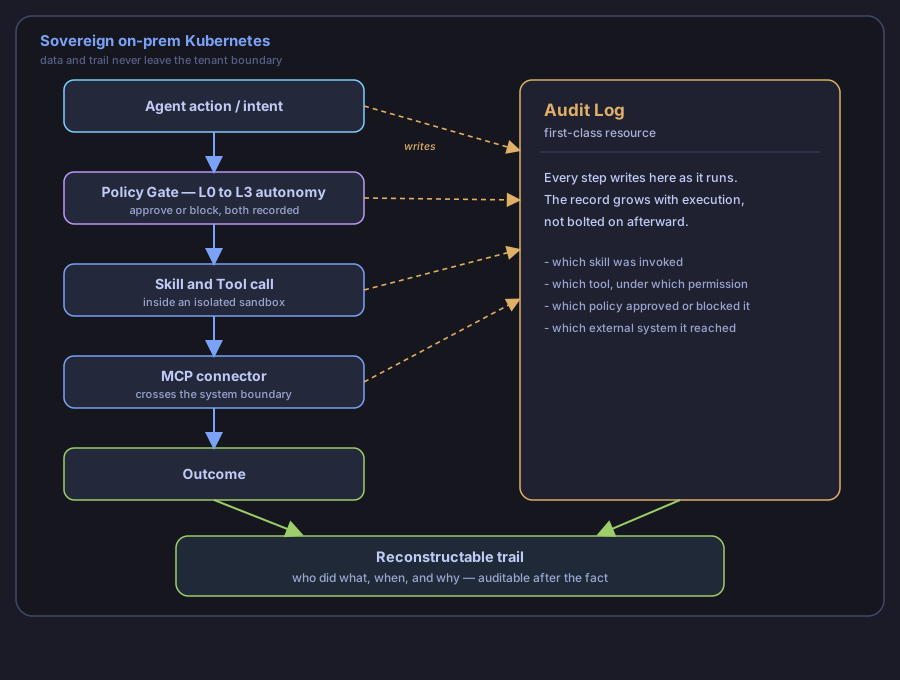
Every execution step an agent takes after passing the policy gate is recorded together as an audit log, and that trail stays inside a sovereign, on premises Kubernetes environment where it can be retraced later.
This structure carries particular value in regulated industries such as manufacturing, the public sector, and finance. The same day, Naver Cloud announced it would team up with Europe’s Mistral AI to jointly develop a manufacturing specific sovereign AI. It is an approach tailored to manufacturers whose data is hard to send outside the company. The government has set the K Physical AI strategy in motion, planning to invest 20 trillion won from public and private sources by 2030 to build a national manufacturing data library and capture even the tacit knowledge of master craftsmen as data, while LG CNS is shifting its business focus toward finance and physical AI. What these efforts share is a constraint that data cannot leave the premises, and a requirement to hold on to the traces that automated decisions leave behind. Sovereignty and audit trails are not two separate demands, they are the same demand seen from the front and the back.
Autonomy, too, is handled as a dial rather than a switch. Paxis governs an agent’s degree of autonomy across levels from L0 to L3. Sensitive work like credit review stays at a lower autonomy level with a human approval step built in, while low risk, repetitive work can be opened up to a higher autonomy level. The after the fact verifiability that the AI Framework Act demands and the controllability that the financial sector needs only become real when policies, audit logs, and the autonomy dial move together as one. If execution happens inside an isolated sandbox, and that sandbox runs on a sovereign, on premises Kubernetes cluster, an organization can keep every trail inside domestic infrastructure without ever sending data outside. That is exactly the picture financial and public sector clients confined to network segregated environments actually need.
What has become commonplace, and what has become scarce
Today’s market showed, from several angles, how fast intelligence and compute are turning into commodities. A small model beats a big one, the best models get given away for free, and chips keep switching vendors. KT is signaling 1 gigawatt and SKT 15 gigawatts of data center capacity, widening infrastructure supply as well. All of this pushes the price of intelligence down.
Whatever loses value always sits next to something that gains it. The more commonplace intelligence becomes, the more valuable the ability to prove what that intelligence autonomously did becomes. The fact that agentic AI was the headline topic at ICML 2026, held in Seoul for the first time, suggests that even the frontier of research is converging on this same problem. The question enterprises are really asking an agent now is no longer how smart are you, but can I retrace what you did. Building an execution layer that can answer that question on its own, that is the real task left standing once the age of raw intelligence has passed.
References
- 中 앤트그룹, 로봇 최대 난제 ‘유리·거울 인식’ 모델 공개 · AI타임스
- 하나금융융합기술원, 금융 업무용 AI 모델 공개…기업여신·상담 지원 적용 · 더데일리포스트
- 2026년 1월 시행 앞둔 ‘AI 기본법’…한국, 세계 첫 전면 적용 국가 되나 · MS투데이
- 슈퍼마이크로, 70억 달러 유상증자로 엣지부터 초대형 데이터센터까지 공급 확대 · ZDNet Korea
- 네이버클라우드, 미스트랄AI와 제조 특화 소버린 AI ‘동맹’ · ZDNet Korea
- 산업 하프타임: ‘3개월 1만 대’ 물량…’K-피지컬 AI’ 민관 20조원 엔진 가동 · 디지털데일리
- 오픈AI와 앤트로픽, 스타트업 잡으려 컴퓨팅 무료 공세 · 한국경제
- 세계 1만5천 AI 석학들 서울 총집결…ICML 2026, 한국 AI 위상 높인다 · 인공지능신문
- KT, ‘AX연결 허브’ 도약…수요 기반 AI 인프라 확충 · ZDNet Korea
- SKT, 15GW 규모 AI 데이터센터 구축…”아시아 AI 인프라 허브될 것” · SK텔레콤 뉴스룸
</content>