AI That Can Now See Through Glass, Yet What Companies Really Ask Is ‘What Exactly Did You Just Do?’
AI Steps Outside the Screen, and the Weight of a Wrong Answer Changes
Scanning this morning’s headlines, AI seems to be growing in two directions at once. One is seeing better. Ant Group unveiled a next-generation vision model that recognizes surfaces older vision models used to miss, glass and reflective materials among them, and claims its 1.1-billion-parameter model outperforms models in the 7-billion-parameter class. The other is moving more. The government and private sector launched a 20-trillion-won K-Physical AI investment push, Ulsan formed an industrial AI hub consortium, and robotics foundation model startup RealWorld hired a former AWS global strategy leader as it moves into commercialization.
In short, AI’s senses are widening and its hands are multiplying. But a wrong answer carries a very different weight depending on whether the AI lives inside a screen or on a factory line. If a chatbot writes a wrong sentence, you simply delete it. If a robot arm moves incorrectly or a manufacturing agent opens the wrong valve, that becomes an irreversible physical event. This is the question today’s news quietly points to. As AI sees better and acts more, the question enterprises actually ask shifts from “how smart is it” to “prove exactly what you just did.”
Today’s Digest Contains Two Different Kinds of ‘Records’
Two kinds of records with different natures sit side by side in the same digest. What Ant Group’s vision model deals with is a record of perception, a story about how precisely it sees the world and how it understands space. The action records covered in IT Chosun’s “AI operations” feature are a different matter. It is about preserving the entire execution flow: which tools an agent called, what permissions it exercised, and what those actions changed.
Without the first kind of record, AI becomes dumb. Without the second, AI never gets adopted. This distinction matters, because performance is proven by benchmarks, while trust is proven by logs. As the article notes, observability platforms like Datadog abroad are strengthening features that trace an agent’s tool calls and responses as a single execution flow, and tools like AgentOps, Arize, and LangSmith are moving toward bundling tracing, evaluation, and governance guardrails together. It is a sign that the observability market is quickly reorganizing from traditional APM toward agent-specific tooling.
Models Are Converging Toward Free, and What’s Left Is ‘Operations’
Another piece of today’s news overlaps with this. OpenAI and Anthropic have started giving away tokens for their top-tier models free of charge, entering a race to lock in early customers. Frontier AI companies are effectively replaying the strategy cloud providers once used, winning startups over with free credits. It is also evidence that the focus of competition has shifted from building the best performance to ecosystem lock-in.
As the era when model performance set the price fades, and even top models are given away for free, the differentiator an enterprise can hold onto comes down not to the model itself but to the operational layer running on top of it. The remaining question is not which model you use, but how you control and record what the agents built on that model can and cannot do. The more attractive free tokens look, the higher the switching cost climbs once you have tailored your prompts and agent harness to a particular vendor. In a phase where performance is leveling out, the real asset is not the model but operational discipline.
Infrastructure Is Being Laid Down, but the Real Contest Happens on Top of It
News on the underlying hardware side points the same way. An industry analysis published today diagnoses that the axis of AI dominance is shifting from “GPU monopoly” to “spreading infrastructure demand.” KT is adding AI growth on top of its core telecom business and expanding into gigawatt-scale data centers, while Supermicro, the bellwether of AI servers, raised 7 billion dollars to widen its supply chain from the edge to hyperscale data centers. Compute, power, and servers are being laid down fast.
The problem is that as the foundation becomes commoditized, the real contest moves further up the stack. Anyone can build a data center, and a GPU is ultimately the same chip everywhere. The differentiator that remains narrows down to how you control agents running on that compute and what you record about them. As welcome as the news that Naver Cloud is teaming up with a European AI player to target the manufacturing market, or that Supermicro’s fundraising is growing, may be, if you do not start designing the operational layer that will run on top of it now, that infrastructure investment can end up being just a cheaper window for running someone else’s model.
As Adoption Spreads, So Does the Demand for Auditability
Several domestic adoption stories also stand out today. LG CNS is ramping up its financial and physical AI businesses, while Krafton and CJ Olive Young jointly hosted an “AI-native” hackathon, letting two very different industries, gaming and retail, share an AI development culture. Daekyo CNS acquired network and security firm Handreamnet, expanding its IT portfolio to bundle AI with security.
Adoption is moving beyond a single department’s experiment into an industry-wide phase. But as the base of adoption widens, so does the number of situations where you must explain what that AI actually did. When an agent built jointly by a game company and a retailer handles customer data, or when an IT firm that now owns a security business expands automation, the question left standing is always the same: can you reconstruct after the fact the path the system’s decision took? The faster adoption moves, the more glaringly the absence of this preparation shows.
Regulation Is Forcing This Timeline Forward
If this were a matter of preference, companies would have pushed audit logs down their priority list. But regulation is pulling this timeline forward. In Korea, the Basic AI Act, which took effect in January 2026, imposes specific obligations on high-risk AI systems and generative AI. Abroad, the EU AI Act and NIST AI RMF are moving toward requiring log retention and auditability for high-risk systems.
Especially in tightly regulated industries such as finance, healthcare, and the public sector, companies expanding agent automation will find it hard to sustain either internal controls or external accountability if they fail to preserve tool call histories and permission exercise records. That today’s digest includes Hana Financial Convergence Technology Institute unveiling a finance-specialized AI model that supports corporate lending and consultation sits on this same context. The deeper AI is embedded in the financial domain, the more it comes with the requirement that the path of the AI’s judgments be reconstructable after the fact. The capability to mask and encrypt observability data and manage its retention period is expected to become a new demand source for domestic cloud and SaaS providers.
The More Physical the AI, the More Evidence Becomes a Prerequisite, Not an Option
This brings us back to physical AI. The government’s physical AI budget targets not a single robot product but the entire value chain running from data to world models, robot foundation models, and factory deployment. Allocating more than half of the budget to demonstration and diffusion infrastructure reflects the judgment that physical AI cannot be validated by software alone and needs an environment where actual equipment, robots, and logistics operate.
AI that moves in the physical world cannot undo a mistake. That is why an action record, a mere convenience for a chatbot on a screen, becomes a prerequisite for an agent on a factory floor. If you fail to preserve what it sensed, what action it chose under which policy, and whether that authority was justified, then when an accident happens, there is no way left to assign responsibility or prevent a recurrence. If the national manufacturing data library is a data sovereignty strategy that refuses to hand Hyundai, Samsung, and LG’s on-site data over to foreign models, then recording and auditing, within domestic infrastructure, what an agent trained on that data does on the floor is the other half of that sovereignty.
Where ThakiCloud Stands: Auditability as the Default
This is exactly where the reasoning behind why ThakiCloud designed Paxis connects. Paxis is a full product built around the concept of an Agent-Native Cloud, and it treats Skills, Tools, Policies, and Audit Logs as first-class resources. That means it does not stop at defining what to task an agent with (Skills) and which tools to hand it (Tools); it places what an agent must not do (Policies) and what it did (Audit Logs) on the same architectural layer. It embeds the execution-flow tracing that today’s IT Chosun article calls for, decision paths, the order of tool calls, and permission exercise records, as a default behavior of the platform, not as a dashboard bolted on afterward.
On top of this sits autonomy governance ranging from L0 to L3. Even for the same agent, it splits how far the agent may decide on its own and where it must obtain human approval into stages, with a policy gate at every boundary, and whether that gate was passed is preserved in the audit log. External tools run inside isolated sandboxes, and a record accumulates at every point connected through an MCP connector. Model selection per task is handled by CostRouter, so the operational layer does not waver whether the free-token race intensifies or a particular vendor raises its prices. And because all of this runs on sovereign, on-premises K8s, sensitive manufacturing floor data and the action records of the agents that moved on that data never leave the company’s boundary.
To sum up, the pain points enterprises revealed across today’s digest branch into four. Auditability to answer regulation and internal controls, sovereignty to keep data from leaking outside the company, safe execution that avoids causing accidents in the physical world, and a cost structure that does not waver even as model prices swing. Each of these four surfaced from a different piece of news, but on the actual adoption floor they are all demanded at once, from a single operational layer. That is exactly why Paxis places Audit Logs, sovereign K8s, policy gates, and CostRouter on the same platform. Right now, with ICML 2026, the world’s largest machine learning conference, being held in Seoul and lending momentum to the domestic research ecosystem, we believe the final stretch that actually carries research achievements onto the factory floor will ultimately be filled by the maturity of this kind of operations.
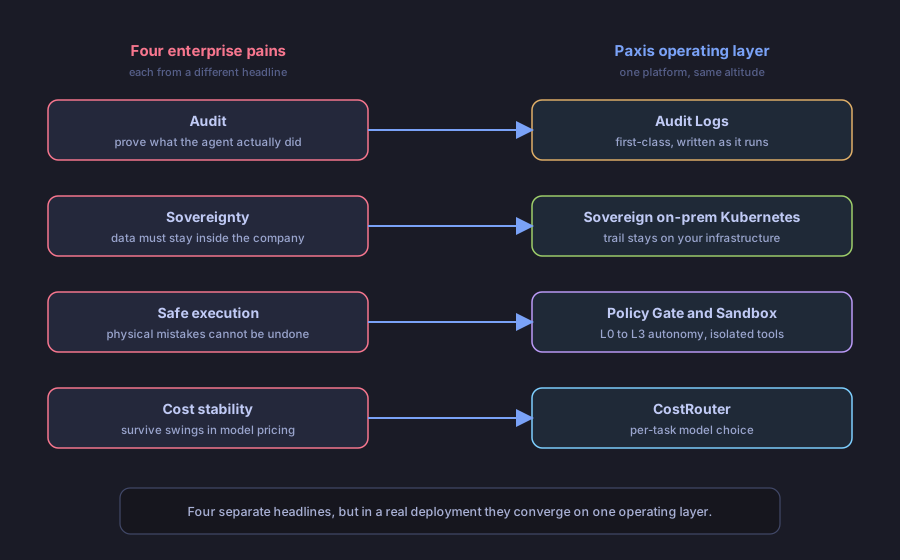
Four pain points, auditability, sovereignty, safe execution, and cost stability, each surfacing from a different piece of news, converge on the actual adoption floor into a single operational layer called Paxis.
Today’s news was full of stories about giving AI better eyes and more hands. That direction is clearly the right one. But what decides whether those eyes and hands can actually be brought onto the floor is not the moment performance improves by another notch, it is whether you can immediately answer the question “show me what you just did.” As senses and actions grow, so does the weight of evidence. The enterprises that prepare an operational layer with that evidence built in as the default will be the ones that come out ahead in the adoption race of the physical AI era.
References
- 앤트그룹, ‘유리’까지 인식하는 차세대 비전 AI 공개…12개 벤치마크서 SOTA · AI타임스
- 산업 하프타임 ⑩ 中 ‘3개월 1만 대’ 물량…’K-피지컬 AI’ 민관 20조원 엔진 가동 · 디지털데일리
- 울산, 제조업 AI 전환 시동…민관 AX 협의체 출범 · 부산일보
- 리얼월드, 글로벌 진출 리더로 AWS 출신 ‘카르틱 크리슈나무르티’ 영입 · 로봇신문
- 오픈AI·앤트로픽, 무료 토큰으로 스타트업 쟁탈전 본격화 · ZDNet Korea
- KT, 통신 본업에 AI 성장 더한다…1GW 데이터센터 확장 기대 · 이데일리
- 2026년 1월 시행 앞둔 ‘AI 기본법’…한국, 세계 첫 전면 적용 국가 되나 · MS투데이
- 하나금융, 금융 AI 자체 개발…기업여신·내부통제에 활용 · 디지털데일리
- 네이버클라우드, 미스트랄AI와 제조 특화 소버린 AI ‘동맹’ · ZDNet Korea