Three Giants, Three Futures: What Hassabis, Huang, and Amodei Leave for Builder Organizations
Three People Reading the Same Wave Differently
In January 2026 at Davos WEF, two people from the AI industry sat at the same panel table: Demis Hassabis of Google DeepMind and Dario Amodei of Anthropic. Same seats, very different words. Hassabis was blunt: “Today’s systems are nowhere near AGI. Solving a few of Erdős’s unsolved math problems doesn’t change that” (Fortune, 2026-01-23). Amodei, in an essay published a few days earlier, had warned that 100 years of economic change would compress into 5-10 years (CNBC, 2026-01-27).
Jensen Huang, on the GTC stage, was talking about something else entirely, not AGI timelines but the infrastructure and agents of right now. NVIDIA’s 75,000 employees working alongside 7.5 million AI agents; one engineer managing hundreds of agents (Fortune, 2026-03-19; NVIDIA GTC Taipei official blog, 2026-06).
All three stand at the AI frontier. Yet looking at the same phenomenon, they draw different futures. This is not a simple difference of opinion, it is a structural difference shaped by each person’s organizational position, risk landscape, and interests. Within that difference lies what builder organizations need to take.
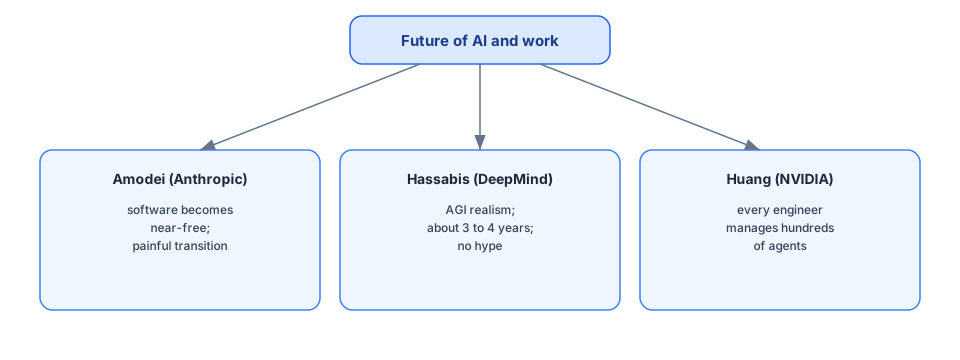
Comparing the three giants’ views of the future
Demis Hassabis: Without Understanding, It Is Not AGI
Hassabis’s worldview can be summarized in one word: understanding.
The analogy he reached for at Davos in January 2026 was simple. Solving International Mathematical Olympiad problems, or cracking Erdős’s number-theory puzzles, does not qualify a system as AGI. The real criterion is the ability to independently propose new physical theories, the so-called “Einstein test” (CryptoBriefing). He draws a firm line between pattern-matching and genuine understanding.
This perspective connects to his career arc. Beginning with game AI, moving through AlphaFold to solve protein structure prediction, and now executing an AGI roadmap, each step opens a new layer of understanding. Hence his timeline carries both optimism and caution together.
At Davos in January 2026 he offered 5-10 years, saying “one or two more fundamental breakthroughs are needed.” Then, four months later in a May 2026 Axios interview, he moved the timeline forward. “AGI is coming, perhaps within five years,” he said, admitting he had “deliberately used provocative language” (Axios, 2026-05-26). That same month, introducing Gemini Omni, the words he chose were “major leap in world understanding.”
Hassabis’s position, in the end, is this: current systems are not AGI. But a breakthrough is drawing closer. The criterion for judging whether that breakthrough is real is not a technical benchmark but a philosophical one, genuine understanding.
Jensen Huang: An Infrastructure Optimist Who Sidesteps the AGI Debate
In Huang’s worldview there is no debate about AGI timelines. What he sees is the structural change happening right now.
In a Fortune interview in March 2026, Huang presented a picture of NVIDIA’s 75,000 employees working alongside 7.5 million AI agents, 100 agents per human. At the GTC Taipei keynote that May, he said “every engineer will come to manage hundreds of agents.” The logic: jobs are not disappearing; they are transforming into the role of directing agents.
Among Huang’s statements, his rebuttal to Amodei’s “software becomes free” claim stands out. In June 2026 he said: “Software companies will not die, because AI agents also need an application layer to process tokens into actual workflows and orchestrate them” (Yahoo Finance). Software’s value does not vanish, the layer shifts.
What is distinctive about Huang’s worldview is how he measures things. At GTC Taipei in June 2026 he described a plan to allocate half of an engineer’s base salary as a token budget to achieve 10x efficiency (Semiconalpha Substack, GTC Taipei keynote transcript). A declaration to measure productivity not by gut feel but by token consumption.
Huang focuses less on when AGI arrives and more on how AI infrastructure is already reshaping the world. His interests lie in hardware and platform, and from that vantage point the world is already changing fast enough.
Dario Amodei: Change Is Fast and the Shock Will Be Uneven
Amodei is the most direct of the three in speaking about labor shock.
In an approximately 20,000-word essay published in January 2026, he warned that AI would cause an “unusually painful” disruption and that 100 years of economic change would compress into 5-10 years (CNBC, 2026-01-27). By May of the same year he was saying that “careers built up across generations may disappear”, not just individual jobs, but entire careers (in the longer time-horizon sense) ceasing to exist.
As Anthropic’s IPO preparations intensified in May 2026, Amodei adjusted his tone somewhat. Fortune reported that he shifted toward an “augmentation” framing (Fortune, 2026-05-26), emphasizing collaboration over labor replacement. This timing shift is worth noting. The structural concerns had not disappeared; it is more accurate to read this as a change in communication strategy.
Amodei’s most provocative claim concerns software economics. “Software will become essentially free. The premise that software development costs must be distributed across millions of users may turn out to be false” (WSJ/Davos 2026, The News.com.pk). A proposition that shakes the very foundation of the SaaS model, and directly collides with Huang’s “the app layer survives” claim.
Amodei leads an organization that pursues AI safety and commercialization simultaneously. His warnings are sincere, but their intensity is calibrated to audience and timing.
Comparing Three Worldviews: A Three-Axis Frame
Placing the three perspectives on the same axes:
| Axis | Hassabis | Huang | Amodei |
|---|---|---|---|
| AGI distance | 5-10 years, breakthroughs needed (2026-01); “possible within 5 years” (2026-05) | Avoids AGI debate; focuses on current agents | “Could be soon”; shock within 10 years |
| Software future | No direct statement | “The app layer survives” | “Essentially free” |
| Labor and human role | Scientific discovery, creative understanding | Managers of agent orchestration | Job redefinition inevitable; some careers extinct |
| Speed of change | Cautious gradualism | Already happening now | 100 years → 10 years compressed; very fast |
| Organizational interest | Google DeepMind, research-led | Hardware and platform infrastructure | Safe AI commercialization, IPO |
One thing emerges from this table: all three may be right simultaneously. They are each describing a different facet of the same reality. Hassabis establishes an epistemological standard; Huang explains the structural shift underway now; Amodei speaks to the social cost. If all three perspectives are correct at once, what should builder organizations do?
What Builder Organizations Should Take from Each
From Hassabis: Build an “understanding standard” inside your organization
Hassabis’s realism is a filter for cutting through AGI hype. His “Einstein test” is a criterion that can be applied within any organization.
When adopting AI tools, the mistake builder organizations frequently make is being seduced by benchmark numbers. A coding assistant passing certain tests does not mean the tool understands. Following Hassabis’s perspective, an organization needs an internal standard that distinguishes where AI is pattern-matching from where genuine understanding is required.
Concretely: repetitive, structured tasks, code scaffolding, document drafting, data transformation, can be delegated to AI. But domains requiring genuine understanding, strategic judgment, the subtle context of customer relationships, organizational design, must remain human-owned. Organizations where this line is blurry paradoxically grow weaker in judgment the more they adopt AI.
Hassabis’s movement on timeline is also instructive. The shift from “5-10 years” in January to “possible within 5 years” in May reflects not market overheating but actual capability progress. Rather than watching the AGI timeline debate from the sidelines, organizations are better served setting their own standards and reviewing them periodically.
From Huang: Build the new capability of managing agents, now
The thing builder organizations should take from Huang’s worldview fastest is agent orchestration capability.
If “every engineer will come to manage hundreds of agents” proves true, a gap is already opening between organizations building that capability now and those that are not. How well you can direct, verify, and orchestrate agents is a new form of technical competence.
Huang’s token budget proposal from GTC Taipei is interesting from an organizational-culture perspective. It is a declaration to measure productivity not through intuition or perceived effort but through AI-utilization data, a Moneyball mindset. Organizations that evaluate developers by commit count or late-night hours, versus organizations that measure AI utilization efficiency with data, will be in completely different positions one to two years from now.
Huang’s “software companies will not die” also connects directly to organizational strategy. Even if Amodei’s “software becomes free” comes true, the value of the orchestration layer that converts tokens into real workflows remains. If you can claim a position in that layer, the impact of falling software prices becomes an opportunity rather than a threat.
From Amodei: Confront the unevenness of the shock and respond preemptively
What builder organizations should take from Amodei’s warnings is the habit of including a social-cost line item in optimistic roadmaps.
Even after his May tone-softening, if “careers built up across generations may disappear” remains valid, the problem organizations encounter first is role anxiety within the team. The faster AI adoption accelerates, the more “will my role be replaced?” shifts from individual anxiety to an organizational productivity problem.
Preemptive response runs in two directions. One is retraining: agent orchestration, AI quality verification, deepening in areas that require human judgment. The other is boundary-setting: when an organization publicly defines “what AI replaces” versus “what AI augments,” role anxiety gives way to role redesign.
That Amodei lowered the alarm level during IPO preparation is a change in external communication strategy. Builder organizations should use the warning itself, not the strategy, as their internal decision-making standard. An organization with optimistic hiring plans but no retraining budget will encounter the internal version of the shock Amodei warned about first.
Organizational Strategy When All Three Worldviews Are Correct Simultaneously
If each of the three perspectives is partially right, how should organizational strategy differ?
If Hassabis is right: AGI has not arrived yet, and the human role in domains requiring genuine understanding continues. AI should be positioned clearly as a supporting tool and core judgment must be protected.
If Huang is right: agents are already reshaping organizations. Build capability and measurement systems now, or fall behind.
If Amodei is right: software economics are fundamentally shifting and the shock will be uneven. Identify the most vulnerable roles inside the organization and create transition pathways.
The organizational principles that accommodate all three simultaneously:
First, do not bet on the AGI debate. Whether it is Hassabis’s 5-10 years or Amodei’s “could be soon,” an organizational strategy tethered to an AGI timeline is always liable to be wrong. Separate from that debate, integrating the maximum AI capability currently available into the organization is a more stable posture.
Second, define agent management as a core competency. In Huang’s worldview, this is already present-tense. How well you direct and verify agents is the new metric of organizational productivity. This capability does not grow on its own.
Third, absorb declining software value by strengthening the orchestration layer. The more Amodei’s “software becomes free” materializes, the more who owns the “app layer” Huang describes becomes the crux of competition. The ability to convert AI tokens into actual business value is the new moat.
Fourth, manage role anxiety inside the organization with data. If Amodei’s warning is right, the shock within organizations will be uneven. Measuring which roles are changing fastest and providing transition pathways is a new leadership mandate.
Conclusion: Uncertainty as the Raw Material of Strategy
The worldviews of the three giants appear to conflict, but in reality each is looking at a different time horizon and different layer. Hassabis speaks to an epistemological standard; Huang to the structural shift happening now; Amodei to the time-compression of social cost.
Betting on only one of the three is dangerous. Taking only Hassabis’s caution means missing the change underway today. Following only Huang’s optimism leaves you defenseless against the shock. Believing only Amodei’s warning means forgoing the opportunities available right now.
The builder’s job is to extract organizational culture principles from the intersection of all three perspectives. Protect the domains that require genuine understanding. Build the capability to manage agents, now. Get ahead of the unevenness of the shock.
Uncertainty is not an obstacle to avoid. At a moment when all three worldviews are simultaneously plausible, the organizations that use that uncertainty as the raw material of strategy are the ones that move to the next level.
Sources
- Fortune / WEF Davos 2026: https://fortune.com/2026/01/23/deepmind-demis-hassabis-anthropic-dario-amodei-yann-lecun-ai-davos/
- WEF Radio Davos podcast: https://www.weforum.org/podcasts/radio-davos/episodes/ai-agi-dario-amodei-demis-hassabis/
- Axios, Hassabis interview 2026-05-26: https://www.axios.com/2026/05/26/deepmind-ceo-demis-hassabis
- Sherwood News, Hassabis AGI 3-4 years: https://sherwood.news/tech/google-deepminds-hassabis-agi-is-3-to-4-years-away/
- CryptoBriefing, Hassabis Einstein test: https://cryptobriefing.com/deepmind-hassabis-agi-einstein-test/
- Fortune, Huang agents/employees 2026-03-19: https://fortune.com/2026/03/19/jensen-huang-nvidia-ai-agents-future-of-work-autonomous/
- Fortune, Huang factory robots 2026-05-06: https://fortune.com/2026/05/06/jensen-huang-servicenow-bill-mcdermott-agentic-ai-robos/
- NVIDIA GTC Taipei official blog: https://blogs.nvidia.com/blog/nvidia-gtc-taipei-computex-2026-news/
- Yahoo Finance, Huang “software companies won’t die”: https://finance.yahoo.com/markets/article/nvidia-ceo-jensen-huang-just-perfectly-explained-the-ai-stock-boom-130835624.html
- Semiconalpha Substack, GTC Taipei keynote transcript: https://semiconalpha.substack.com/p/nvidia-keynote-computex-2026-key
- CNBC, Amodei “unusually painful” 2026-01-27: https://www.cnbc.com/2026/01/27/dario-amodei-warns-ai-cause-unusually-painful-disruption-jobs.html
- The News.com.pk, Amodei “software becomes free”: https://www.thenews.com.pk/latest/1402953-software-will-become-essentially-free-warns-anthropic-ceo-amodei
- Fortune, Amodei tone shift 2026-05-26: https://fortune.com/2026/05/26/sam-altman-dario-amodei-walking-back-ai-jobs-apocalypse-prophecies-ipo/