Rereading Musk’s Davos Forecast: Intelligence in Five Years, and Where That Intelligence Actually Runs
Overview
A post recently made the rounds across several communities. It was framed as a message to Elon Musk, and its thrust was stark. People have at most about three years left to earn a living through labor, it argued, after which most of the jobs that once paid a salary will be automated and there will no longer be a reason to pay a human at all. The post called this the largest wealth transfer in history and concluded that the task now is to convert your time into assets that machines cannot take from you.
The post did not carry only text. It came with an actual video clip of Musk himself speaking. So we pulled the source video and checked, sentence by sentence, what he actually said. The check turned up something worth noting. The number that went viral, three years, was not something Musk said, and the number he did give was a different one. In this piece we first lay out what he actually said, then look at the picture that emerges if we take the forecast seriously, and finally ask, from a tech-blog angle, where this intelligence actually runs.
The clip above is the one that went viral. It is reported to be part of a conversation with BlackRock CEO Larry Fink at the World Economic Forum in Davos.
What Musk Actually Said
Transcribed, Musk’s remarks compress into three predictions. In his own words: “In five years, so five years being say 2031, I think digital intelligence will exceed the sum of all human intelligence.” “There will be, in five years, probably at least a hundred million humanoid robots, but maybe a billion.” “I will predict that the economy is probably twice its current size in five, maybe six, seven years, because you are going to hit a doubling period, where economic output is increasing so fast that, plus or minus a few years, you will see giant changes.”
Three claims, then. First, in about five years digital intelligence surpasses the sum of all human intelligence. Second, over the same span humanoid robots grow to somewhere between 100 million and 1 billion. Third, the economy doubles within five to seven years. Every one of these is on a five-year clock, not a three-year one.
Here is the accuracy point worth pinning down. The viral “three years” was not Musk’s statement but a framing the post’s author added on top of the clip. Musk spoke about changes to intelligence, robots, and the economy over five years, and the author compressed the front edge of that change, the time a person can hold on through labor, into a dramatic three. Distinguishing the two numbers is where this discussion has to begin. Faithful to the source, the horizon we should be discussing is around five years, and the subject is the relationship between intelligence and labor, not a shopping list of assets.
Why We Take the Forecast Seriously
Time-bound predictions deserve caution, but the direction of this one rests on grounds that are hard to dismiss. We largely agree with the broad direction, and it is worth stating the reasons alongside the evidence.
First, intelligence. Over the past few years, the ability of language models to write code, draft documents, handle customer inquiries, and analyze data has climbed faster than many expected. Tasks people kept assuming machines could not do have fallen one after another. As long as performance keeps improving predictably with the compute and data poured into training, the picture of collective intelligence tipping toward machines at some point is not fantasy but an extension of the trend.
Second, robots. Humanoids are what it looks like when intelligence stops living only in software and gains a body to extend into physical labor. Whether the count is 100 million or 1 billion depends on manufacturing capacity and cost curves and carries wide error bars, but the direction itself, that a meaningful share of physical work begins shifting to machines, is already visible on factory floors and in logistics.
Third, the economy. When the supply of intelligence and labor rises sharply, output rises, and when output rises fast, an economy enters a doubling period. Musk’s five-to-seven-year doubling is optimistic, but the mechanism is one economics has long studied. Even if the timing slips by a few years, the direction holds.
To be honest, the direction being right and the timing being right are two different things. Roy Amara’s old observation fits technology forecasts well: we tend to overestimate the short-run effect of a technology and underestimate the long-run one. The five-year figure may be off. But the direction is harder to call wrong. It is more honest to say the direction is right and the speed is uncertain.
From Labor to Assets: The Solid Part and the Soft Part
The original post’s conclusion starts by defining a salary as the price of lending out your own time. If machines can do the work of that time more cheaply and reliably, the value of the time you lend falls, and in the end only what you own remains.
Start with the solid part. If the income an economy produces splits between labor and capital, automation tilts the scale toward capital. That returns flow more to whoever owns the machine as machines take over human work is a pattern repeated since the Industrial Revolution, and this round of AI and robotics is widening it across both knowledge work and physical work. The direction, that what you own comes to matter more, is not an unreasonable claim.
Now the soft part. First, jobs have historically changed shape more often than they have vanished outright. Automation removes certain tasks while creating new ones to design, supervise, and stitch them together. This time, though, the newly created tasks may themselves be automated quickly, so the old optimism cannot simply be repeated. Second, the prescription to “therefore buy this particular asset now” contains a leap. There is a wide gap between the diagnosis that income is tilting toward capital and the prescription to buy a given asset today. We do not provide investment advice, and we note plainly that the price of any particular asset is volatile. What this piece deals with is not the ticker but the structure beneath it.
Where That Intelligence Runs
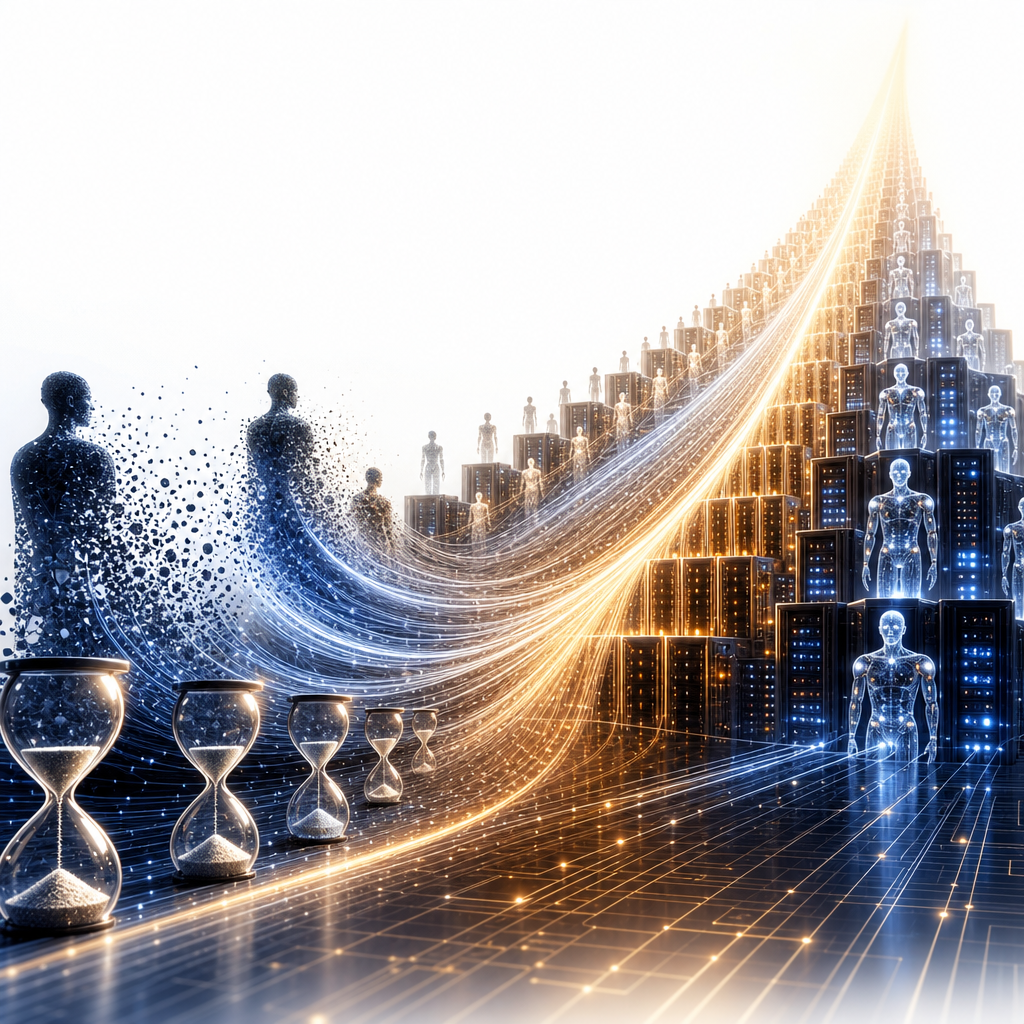
Here we step in from a tech-blog angle. The digital intelligence Musk described, the brains of humanoid robots, and the output that supposedly doubles the economy do not happen in thin air. The actual computation that trains models, runs inference, and controls robots happens on GPUs somewhere. In other words, the physical substance of an intelligence that exceeds the sum of humanity is compute, and the power and infrastructure that keep that compute running.
The old gold-rush line fits here: the real money went less to those who dug for gold than to those who sold the picks and jeans. The more intelligence and labor get automated, the more the compute and power that automation consumes are worth. And here a crucial difference from the original post’s asset thesis appears. Some assets are held but produce nothing, whereas compute infrastructure is held and produces actual work at the same time. If one is a vessel that stores value, the other is a factory that generates it. In an age of automation, the most productive answer to “what should I own” is to own the ability to run the automation itself.
(exchanged for salary)"] -->|replaced / augmented by automation| B["Work done by machines
(knowledge + physical labor)"] B --> C{"Where does the
created value accrue?"} C -->|stores value| D["Scarce assets
(a vessel that produces nothing)"] C -->|generates value| E["Compute, power, infra
(the factory that runs intelligence)"] E --> F["Who owns and
controls that infra?"] F --> G["Individuals: irreplaceable capability
Organizations: their own compute and data"]
Brought down to the individual, this insight is less dramatic but more practical. Rather than rushing to buy assets, for most people the surer preparation is to build within yourself the ability to design, direct, and verify automation, the judgment and context a machine cannot easily replace. Moving from fearing the tool to commanding it is the most honest way to turn time into an asset.
Through ThakiCloud’s Lens
There is a reason we do not treat this topic as someone else’s story. What ThakiCloud builds is precisely that floor on which intelligence runs.
The first lens is ai-platform. ThakiCloud’s ai-platform is AI/ML infrastructure that allocates GPU resources, trains models, and serves inference on top of Kubernetes. One point carries special weight for us. Instead of handing compute wholesale to someone else’s cloud, we let an organization run its own models on its own data in its own environment. On-prem and sovereign AI, low serving cost, and self-hosting are the keywords we return to again and again. Applied to the logic above, it is about returning to organizations the ability to own and control the compute that intelligence consumes. The angle weighs most in public-sector and regulated industries where data sovereignty matters.
The second lens is Paxis. Owning compute is only half. There has to be a control plane that turns that compute into actual automated work. Paxis is an Agent-Native Cloud running on top of ai-platform, treating skills, tools, policies, and audit logs as first-class resources. It selects among hundreds of skills to run in isolated sandboxes, weaves multiple agents into a DAG to collaborate, and passes every action through a policy gate and audit log. If compute is the factory that generates value, Paxis is that factory’s work order and its safety mechanism. Low-cost serving creates the economics of automation, and the agent layer above turns that economics into actual business outcomes.
Put the two lenses together and you get our own answer to the anxiety Musk’s forecast provokes. If automation is an unavoidable direction, then keeping control of that current from concentrating in a few hands and letting more organizations share it is, we believe, the part an infrastructure company can play.
What to Watch Carefully
Agreeing with the broad direction, there are still a few points to hold onto so as not to be swept along.
First, timing. The five-year figure may slip, and the viral three-year one more so. Remembering that full self-driving has been called “ready next year” every year for over a decade, the more precisely a prophecy pins a date, the more its aim tends to be the feeling it stirs rather than the date itself. Believe the direction, but do not believe the calendar.
Next, the prescription. That the diagnosis of income tilting toward capital is right is a different matter from what one should buy now. The latter is usually delivered in a tone of certainty without verification. The more confident the sentence, the more one needs the habit of checking its basis separately.
Last, distribution. If the wealth transfer really is large, it is not a problem solved by an individual’s clever asset choices but one society has to address together. A prescription aimed only at those who can afford to buy assets risks enlarging the very problem it diagnosed. Musk himself has elsewhere floated notions like universal high income, which suggests that distribution after automation is a question at the level of institutions, not individuals.
Closing
The one thing we can reliably take from this clip is this. Automation is real as a direction, and its value accrues to the ability to actually run it: for individuals, as capability that cannot be replaced; for organizations, as their own compute and data. Even if Musk’s five years is not an exact calendar, we largely agree with the direction that the relationship between intelligence and labor is changing. Only, what lies past that door is not a ticker to rush and buy but capability and infrastructure to build up slowly. That is how we reread it.
Sources
- Source video: A clip of Elon Musk in conversation with BlackRock CEO Larry Fink at the World Economic Forum in Davos. The quotes in this piece were transcribed directly from that video.
- Cross-checked remarks: Musk’s five-year predictions (digital intelligence exceeding the sum of human intelligence, 100 million to 1 billion humanoid robots, the economy doubling within five to seven years) were reported by multiple outlets as Davos remarks. Related coverage: Elon Musk predicts robot-majority future in first Davos appearance, Euronews
- The viral phrase “three years” is the framing of the author who quoted the clip, not Musk’s own statement.
- Roy Amara’s observation (short-run overestimation, long-run underestimation) is a widely cited rule of thumb in technology forecasting. Reference: Roy Amara, Wikipedia