The Day Apple’s Crown Sat on Someone Else’s Chips: The AI Era Moves From Owning to Governing
Siri now runs on Google’s GPUs
According to a report by The Information, Apple’s next-generation Siri runs not on its own servers but on Nvidia chips leased from Google Cloud. Its in-house M2 Ultra chip underperformed, and the launch of its successor, the server chip codenamed “Baltra,” has slipped too. More striking still, the brain sharpening Siri isn’t an Apple model at all, it’s Google’s Gemini. The flagship service of the company that has designed its own silicon more closed off than anyone else on earth is now running on a rival’s chip with a rival’s model.
That single scene is the lens for reading all of today’s news. Apple acquired an Israeli startup for two billion dollars, roughly three trillion won, earlier this year and is weighing further semiconductor acquisitions. CFO Kevan Parekh has signaled he will abandon the “net cash neutral” stance the company has held for years. The M-series roadmap has been reshaped too: the M6 ships only in a base configuration, while development is funneled into the AI-focused M7 Pro, Max, and Ultra. Its own AI server chip launch has been pushed back to 2029, and the Broadcom partnership extended through 2031. When Tim Cook steps down this fall, hardware veteran John Ternus takes over.
The company that owned the most started borrowing first
Apple’s myth was “we build everything ourselves.” Chips, operating system, devices, and store were bound into one body, and that control was the weapon. But faced with the wall of generative AI inference, the company that had owned the most became the first to let go of ownership. Apple, of all companies, has now publicly admitted its own chips alone cannot handle inference demand at scale.
China makes this more interesting still. On the same day, Apple launched its local AI service in China with regulatory approval, loaded not with Google’s model but with Alibaba’s Qwen. Depending on the region, an entirely different company’s model clears the regulatory bar: Gemini in the US, Qwen in China, and its own chip replaced by Google’s GPUs. Three different suppliers now sit inside one product. Even Apple is shifting the axis of competition from what it owns to how it combines and governs what it doesn’t.
The physical layer wants owning, the intelligence layer wants borrowing
Korean news ran the opposite direction that same day. SK Telecom set up an “AI DC Integrated Task Force” reporting directly to the CEO, with CTO Jeong Seok-geun at the helm and sixteen executives split across business development and engineering, managing everything from site selection to design, construction, and customer acquisition. The plan starts at 5GW in 2029 and scales to as much as 15GW by 2035. Data center construction has opened into a race worth tens of trillions of won, costs now exceeding 10 billion won per megawatt, and the government’s “AI for All” program backs up to 512 Nvidia B200 units on condition that domestic models make up over 80 percent. GIST has secured a 75-billion-won national AI hub. Everyone is racing to own the physical layer: power, land, GPUs.
The two directions look contradictory but are really the front and back of one picture. The physical layer, electricity, buildings, chips, remains a fight over who secures how much. The intelligence layer running on top, models and tools, is leaning ever more toward being borrowed. Just as Apple swaps Gemini or Qwen by region, most companies will soon mix multiple models and tools to fit the moment. Stack the owned layer as thick as you like: control still vanishes if you cannot govern the heterogeneous stack above it.
The same signal shows up in infrastructure. Microsoft has partnered with 3M to bring next-generation optical interconnects into Azure data centers, because no matter how large a GPU cluster you stack, a bandwidth bottleneck keeps owned resources from performing. Even the physical-layer contest is shifting from “how much do you have” to “how well do you connect and handle it.” Owning scale and governing it are now separate capabilities.
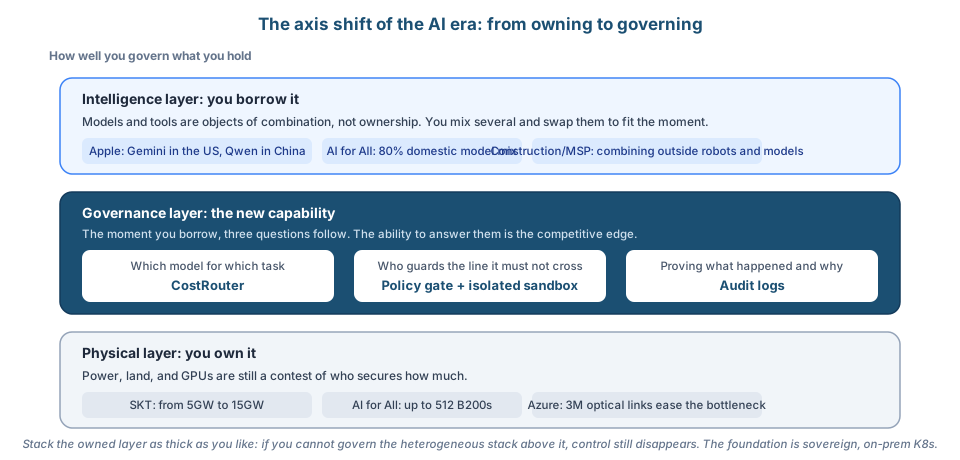
The intelligence layer on top is borrowed. The governance layer in the middle, cost routing, policy gates, audit logs, is the new capability. The physical layer at the bottom, power, land, GPUs, is still owned outright.
AI reaching the field is everywhere borrowed
This isn’t just a Silicon Valley and telecom story. Today’s domestic news carried scenes of AI moving into traditional industry too. Samsung C&T pictures an “AI construction site” where autonomous forklifts run at night and robots take over by day. SK Ecoplant has selected six innovative technologies from semiconductor and AI startups to commercialize, and GS Neotek presented an AX strategy built on Gemini Enterprise at a Google Cloud event.
The common thread is clear: no one is building AI capability from scratch. Construction firms bring in outside robots and models, corporations select and layer on startup technology, MSPs graft hyperscaler models onto their own customers. Each combines borrowed capability on top of the business it already does well. What decides the contest isn’t which technology you own, but how safely and consistently you weave borrowed pieces into your workflow.
Models are not converging into one
For an age of borrowing to hold together, there must be many things to borrow from, and today’s news shows the model world splintering further rather than converging. Anthropic, ahead of its IPO, has been highlighting its edge over OpenAI, signaling a reshuffle among frontier vendors. The World Artificial Intelligence Conference in Shanghai became a stage for China to showcase AI self-sufficiency amid US-China rivalry, and technology blocs are splitting along regional lines more sharply than before.
Korea’s “AI for All” program has written this fragmentation into an actual rule. Participants must combine more than 50 percent of their own domestic model with more than 30 percent of another domestic model, keeping the overall domestic share above 80 percent, mixing several models in fixed ratios rather than filling a service with just one. Half the presentation evaluation score rests not on in-house model performance but on service operation capability, effectively making “how you operate what you borrow” the standard ahead of “what you own.” The active alliances forming among telecoms, portals, and AI firms move the same way: weaving each other’s capabilities together rather than each owning every model alone.
Governance is the new capability
The moment you start borrowing, three questions follow: which model goes on which task, who guards the line that task must never cross, and how do you later prove what happened and why. In the age of ownership these sat inside one walled structure and never needed asking. In the age of borrowing, the ability to answer them is the competitive edge itself. Not ownership. Governance.
Korean startup Reconlabs’ Genpresso revamp, also in today’s news, compresses this shift into a small example: it stores prompts, the model used, and the generated result together as context, accumulates them into reusable “skills,” combines automated review with human approval, and attaches C2PA signatures to output, tracking what was used and who approved it as models get swapped in and out. That is why Reconlabs says “anyone can use AI, but the grammar of production is the asset.” The scale differs, but the challenge is the same one Apple faces swapping models by region: the grammar for governing a heterogeneous stack becomes the asset.
The third question, proving later what happened and why, is the heaviest. Yoo Bong-seok, CEO of AI forensics firm Yurak, stressed using AI in the field to protect data integrity. The wider the range of decisions AI takes on its own, the more a trustworthy record of that action becomes a precondition, not a choice. As borrowed capability grows, auditability becomes governance’s final lock.
Anthropic’s IPO positioning against OpenAI and China’s self-sufficiency showcase in Shanghai sit on the same trend line. Frontier models keep splitting into more branches, regional regulation and demands for sovereignty keep strengthening, and the era of entrusting everything to one model is passing. What remains is always governance: how do you safely weave together capability that is scattered.
Where ThakiCloud has been preparing
This is exactly where ThakiCloud’s Agent-Native Cloud, Paxis, stands. Paxis treats Skills, Tools, Policies, and Audit Logs as first-class resources, and each pain point in today’s news makes clear why.
Cost first: just as Apple weighs its own chips against leased GPUs, attaching the priciest model to every task is unsustainable, and CostRouter, which picks the right model per task, turns Apple’s region-by-region Gemini/Qwen swap into an organization-wide policy. Safe execution next: autonomy dials from L0 through L3 and policy gates fix in code the lines an agent must not cross, while an isolated sandbox contains borrowed-tool execution, a boundary that must get stricter the more an automation moves physical objects, as with Samsung C&T’s field robots. Then audit: as Yurak’s CEO Yoo stressed on integrity, every execution lands in audit logs that later prove what happened and why. Finally sovereignty: MCP connectors and the skills marketplace weave borrowed capability together in one place, and because they run on sovereign, on-premises K8s, they meet domestic demand to protect sovereignty at the physical layer too.
Apple running its own service today on someone else’s chips and someone else’s models is the tomorrow most companies will soon face. What you own no longer decides the edge; how well you govern what you borrow decides the next contest.
SKT racing toward 15GW and the government dividing up 512 GPUs show the ownership contest is already heated. But the governance capability to safely weave together multiple models and tools on top of it is not ready in most organizations yet, and even Apple has only just begun wrestling with the problem. Whichever side builds the skeleton of governance first is the one that puts its own resources to full value even in the ownership contest. The time to start preparing for governance is now.
References
- MacRumors: Apple’s next-generation Siri to run on Google Nvidia chips
- AppleInsider: Apple weighs AI chip startup acquisitions under new CEO, drops net cash neutral
- TechRepublic: Apple’s M6/M7 chip roadmap reshaped around AI
- MacRumors: Apple and Broadcom extend custom chip deal through 2031
- 9to5Mac: Tim Cook steps down, John Ternus confirmed as successor CEO
- TechCrunch: Apple’s Alibaba Qwen-based AI service approved for China
- Financial News: SKT’s 15GW AIDC integrated task force, CTO Jeong Seok-geun, 16 executives
- Seoul Economic Daily: AI for All program, 512 GPUs, 80% domestic model share
- ZDNet Korea: GIST wins 75-billion-won HPC/AI infrastructure project
- Microsoft Source: Microsoft and 3M partner on AI data center optical interconnects
- Sports Kyunghyang: GS Neotek presents AX strategy built on Gemini Enterprise at Google Cloud event
- Kyunghyang Shinmun: Shanghai World Artificial Intelligence Conference opens, China showcases self-sufficiency amid US-China AI rivalry
- Venture Square: Reconlabs overhauls Genpresso with skills, C2PA, and human approval
- Forbes: OpenAI vs Anthropic IPO comparison, Anthropic’s competitive edge