Putting a Safety Net Under Autonomous Skill Rollout with Canary Gates: Trace-Based Regression Detection and Automatic Rollback
This post is written for cloud and AI engineers who are wrestling with how to safely push into production, the next day, whatever skills or configurations an unattended overnight pipeline produced on its own. As more autonomous harnesses start rewriting their own code, there is still no standard for the procedure that decides how the fixed result actually gets routed to real traffic. The paper introduced today proposes a concrete design that inserts canary releases and automatic rollback into this rollout stage, and it puts the effect to the test through simulation.
The problem: unvalidated full rollout
The starting point of the problem is the authors’ own prior work. It described a production harness with more than 1,600 skills that, overnight and without human review, diagnoses its own routing and retrieval failures and regenerates retriever configurations and decomposition rules. The problem was how the result got deployed. The regenerated candidate started serving 100 percent of all traffic the very next morning. Even if the candidate had passed checks within the offline recovery loop itself, there remained a real possibility that it would perform worse on live traffic, and in that case every request for the rest of the day would keep hitting the regression until a human noticed. This paper directly measures how much blast radius and mean time to recovery (MTTR) improve, compared to this unverified full rollout, once a gradual traffic canary with a deterministic, trace-triggered rollback gate is inserted between “the generated candidate” and “the candidate serving all traffic.”
Calibrating the gate by calculation, not by feel
The first contribution is that the gate was not set by feel. The window size (W) and error threshold (k) of the sliding-window regression detection gate were chosen through an exact binomial tail-probability search, tuned so that at a baseline error rate of 0.03 the false-positive probability for a single window comes out to 2.12*10^-6. The authors did not hide their process along the way, either. An early draft used a naive setting of window size 10 with a 30 percent threshold (3 errors), and during the binomial calibration process they discovered that this setting would almost certainly produce a false positive even at the baseline error rate, and corrected it before the final experiment. The key point of this disclosure is that the mistake was caught by calculation before the results came in, not discovered after the fact from the results themselves.
Experiment design: 360 reproducible simulations
The experiment is a fully offline, seed-fixed, reproducible simulation. A stream of skill-invocation outcomes across 20,000 ticks was generated, and at the 2,000th tick a regression was injected in which the error rate jumps in a step. Two policies, full rollout (canary weight 1.0, where v2 receives traffic on every tick) and canary (weight 0.1, where v2 receives traffic on only one tick out of ten), were compared under the identical gate, and three regression severity levels (error rates of 0.15, 0.35, and 0.6, against a baseline of 0.03) were each multiplied by 60 seeds, for a total of 360 runs. The result was unambiguous: across all 360 runs there were zero false positives, and the detection rate was 100 percent.
Result 1: the 90% blast-radius cut is a design artifact
Canary cut the blast fraction from 1.0 to 0.1, a 90 percent reduction. But the authors do not present this number as a headline finding. That is because, once the canary weight is set to 0.1 and detection always succeeds, the blast fraction converging to roughly 0.1 is nearly a foregone conclusion by design. The paper itself points out that the blast-fraction reduction coming out to exactly 90.0 percent for all three severities is itself evidence that this figure is not a measurement but a structural byproduct of the routing weight.
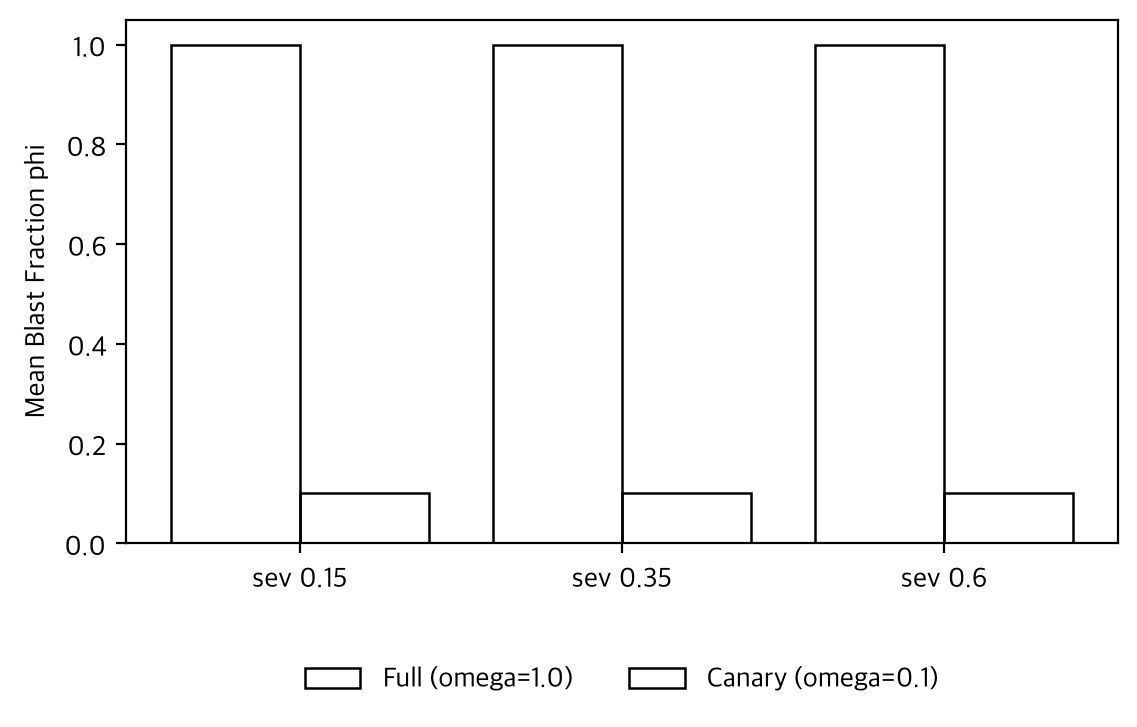 Canary (weight 0.1) lowers the blast fraction to 0.1 across all three severities compared to full rollout (weight 1.0). However, the paper explicitly states that this 90 percent reduction is not an empirical finding but a structural result of the canary weight design. This is an analytical figure visualizing the simulation data.
Result 2: how many buggy invocations actually shipped
What carries more weight as an actual measurement is the absolute number of invocations that v2 was really exposed to. Under full rollout, an average of 2,012 to 2,160 requests hit the buggy version outright after the regression occurred. Under canary, that number dropped to 212 to 378. The reduction ranged from 82.5 percent (at error rate 0.15) to 89.5 percent (at error rate 0.6) depending on severity, and notably, the smallest reduction occurred for the mildest regression. That is because canary takes longer to detect a mild regression, and v2 exposure accumulates correspondingly more in the meantime.
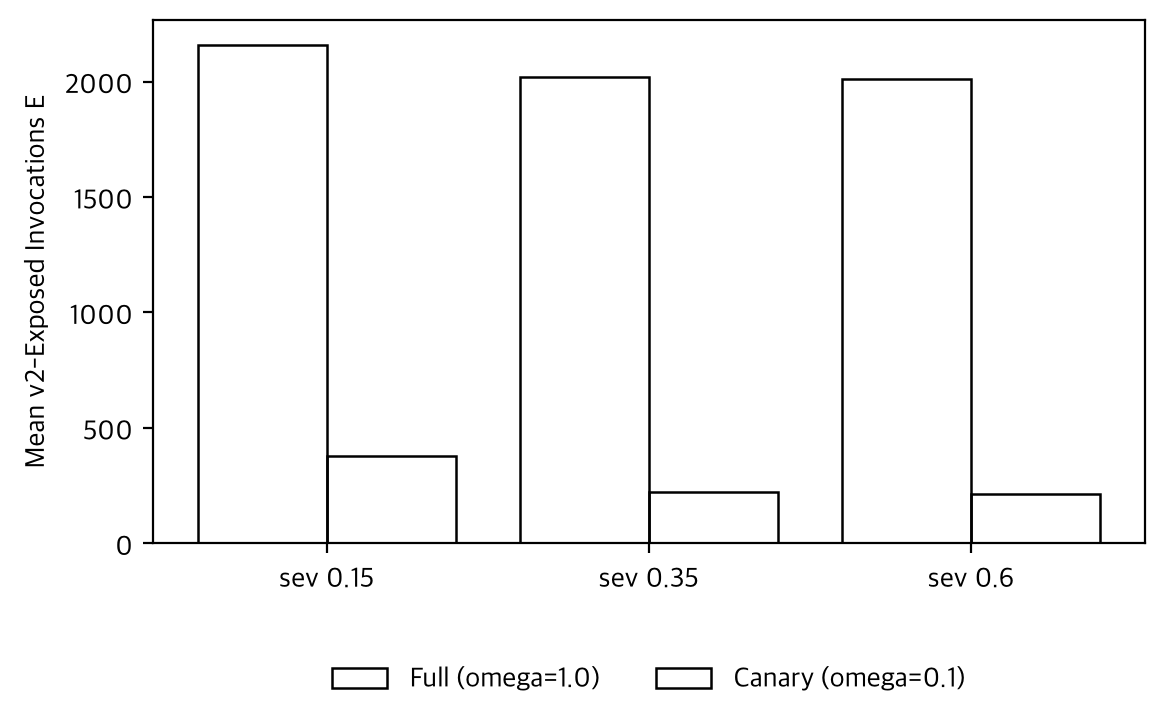 Full rollout leaves roughly 2,000 invocations exposed to the buggy version, while canary cuts that down to 212 to 378. The smallest reduction occurs for the mildest regression, showing that exposure grows in step with longer detection time. The result comes from a local benchmark run in the repository itself (measured on July 19, 2026).
The real finding: the MTTR gap narrows as severity grows
What this paper can genuinely call a “finding” lies elsewhere. Canary took longer to roll back than full rollout at every severity level, but that gap narrowed sharply as the regression grew more severe. For the mild regression (error rate 0.15), full rollout rolled back in 30,864.6 milliseconds while canary took 53,841.7 milliseconds, about 74.5 percent slower. At medium severity (error rate 0.35), the gap shrank to 8.86 percent, and at severe regression (error rate 0.6), it shrank further to 4.82 percent. The cause lies in how the gate operates. The gate requires at least 30 accumulated v2 invocation outcomes, of which at least 8 must be errors, before it fires. Full rollout fills this 30 almost immediately since every tick is a v2 invocation, but canary only sends traffic to v2 on one tick out of ten, so filling the same 30 requires roughly ten times more total system ticks. A mild regression already needs the window to be checked multiple times before it crosses the threshold, and canary’s traffic dilution multiplies on top of that, producing a much larger delay. Conversely, a severe regression crosses the threshold on the very first window check right after the regression begins, so the gap between the two policies shrinks down to just the difference in time needed to fill that single first window.
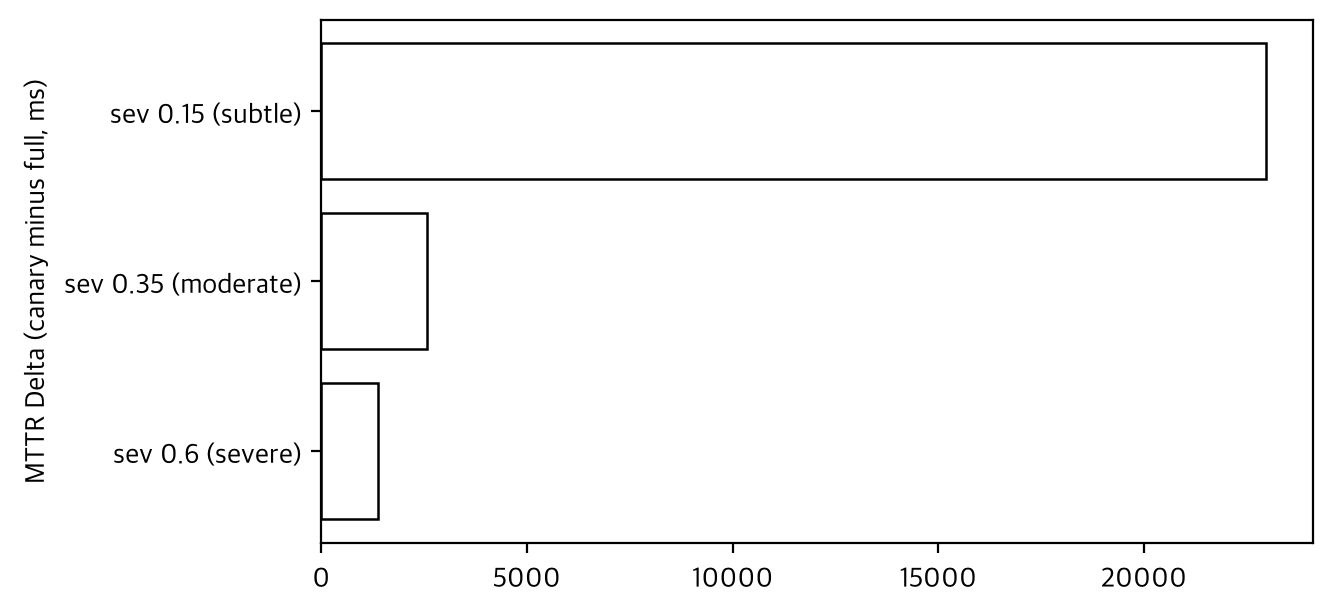 Canary’s MTTR penalty reaches roughly 74.5 percent for mild regressions but drops below 9 percent for severe ones. This severity-dependent gap is the result the paper actually newly measured. The MTTR figures are computed from seed-sampled sums drawn from six real observed latency values (12.705, 35.029, 25.011, 6.271, 6.458, and 0.004 milliseconds) pulled from this repository’s own observability span logs.
One more thing worth noting is that these MTTR figures are not made-up numbers. They were seed-fixed samples drawn from a pool of six real latency values actually left behind by the repository’s own observability pipeline (the smoke test in scripts/harness/span.py). The authors themselves immediately acknowledge the limitation that this pool has only six samples.
Three layers of significance, and the stated limits
The practical significance of this research falls into three layers. For the ThakiCloud AI platform, it provides practical grounding: once overnight autonomous skill evolution and retrospective-driven model promotion are actually reflected in scheduled runners, inserting a canary with an automatic rollback gate to shrink the blast radius of an unverified full rollout can secure a safety margin for 24-hour unattended operation. Looking more broadly, in the growing trend of self-modifying AI where agents fix their own code or skills, this pattern of pairing a deterministic trace-based regression gate with automatic rollback has room to become a reusable standard component for autonomous system safety. Academically, whereas existing canary-deployment research has mostly treated microservices or web traffic as the unit of deployment, this paper extends the deployment unit to “a skill generated and modified by an autonomous agent.” The methodology of handling the nondeterministic quality of LLM output not through the model’s own self-report but through a deterministic, code-owned gate built on span traces adds a new axis to the literature on self-evolving agent harnesses. In its related-work discussion, the paper positions itself against MOSS’s binary health-probe and full-traffic-swap approach precisely along this axis, contrasting it with its own gradual traffic canary and statistical regression gate.
The paper is also lengthy and honest about its own limitations. The heaviest one is that the entire experiment is a fully synthetic outcome stream. No real skill was ever deployed to a real traffic split, and no real rollback was ever executed. It repeatedly notes that the latency pool consists of only six real measured spans and cannot represent actual production latency distributions or tail behavior, and that the 90 percent blast-radius reduction is not a finding but a structural result produced by a canary weight of 0.1 combined with a perfect detection rate. Because only a single gate configuration (window size 30, threshold 8) was tested, the Pareto frontier between MTTR and blast radius has not yet been mapped. The regression model is also just one step-increasing Bernoulli error rate, so the results may not transfer as-is to other failure modes such as gradual drift, latency-only degradation, cost blowups, or semantic quality decay. Above all, this paper only proposed the canary-and-rollback mechanism and validated it through simulation; it was not directly implemented in a real production recovery loop or the harness’s live observability code.
More details and the full data are available on the Hugging Face paper page.
https://huggingface.co/datasets/thaki-AI/daily-paper-2026-07-20-canary-gated-skill-rollout