When Can You Trust the Cheap Model: Cutting Multilingual Document OCR Costs with a Confidence-Gated VLM Cascade
Any engineer who has hooked a VLM into a document parsing pipeline has probably faced the same fork in the road at some point. A model with well under a billion parameters can read most documents just fine, yet the moment a scan is degraded or written in an unfamiliar script, that same small model confidently produces the wrong answer. Routing every document to an expensive, large VLM instead isn’t affordable either. The paper introduced in this post formalizes that fork in the road as a cascade governed by a single confidence threshold, and points out that the very moment the confidence signal itself becomes least trustworthy happens to coincide with the moment the cascade needs it most. It’s worth a read for any cloud or AI engineer in Korea designing document OCR or VLM serving costs.
The Problem: Cascades Worked for Text, But Do They Work for Images Too?
Cascade routing, where a cheap model runs by default and only escalates to an expensive model when confidence is low, is already a proven technique in text LLM serving. FrugalGPT is the flagship example, reporting cost reductions of up to 98% while maintaining quality comparable to using only the top-performing model. The question is whether this idea transfers directly to document OCR. Unlike text prompts, document images vary wildly in difficulty along three axes: scan quality, language and script, and layout complexity. A confidence threshold tuned for cost-optimality on a clean English invoice can be completely off the mark on a distorted low-resource-language scan, and that mismatch is the paper’s core starting point.
Core Contribution: A Single Confidence Threshold Traces the Entire Pareto Frontier
The paper builds a two-stage cascade consisting of a cheap VLM (a sub-billion-parameter model on the order of PaddleOCR-VL) and an expensive large VLM, parameterized by a single confidence threshold τ. In this structure, where escalation to the expensive model happens only when the cheap model’s confidence score falls below τ, the paper derives the escalation rate, expected cost, and expected error rate all as functions of τ. What’s interesting is that “always use the cheap model” and “always use the expensive model,” which practitioners often treat as separate options, turn out to be nothing more than the two endpoints, τ=0 and τ=1, of this single parameter family.
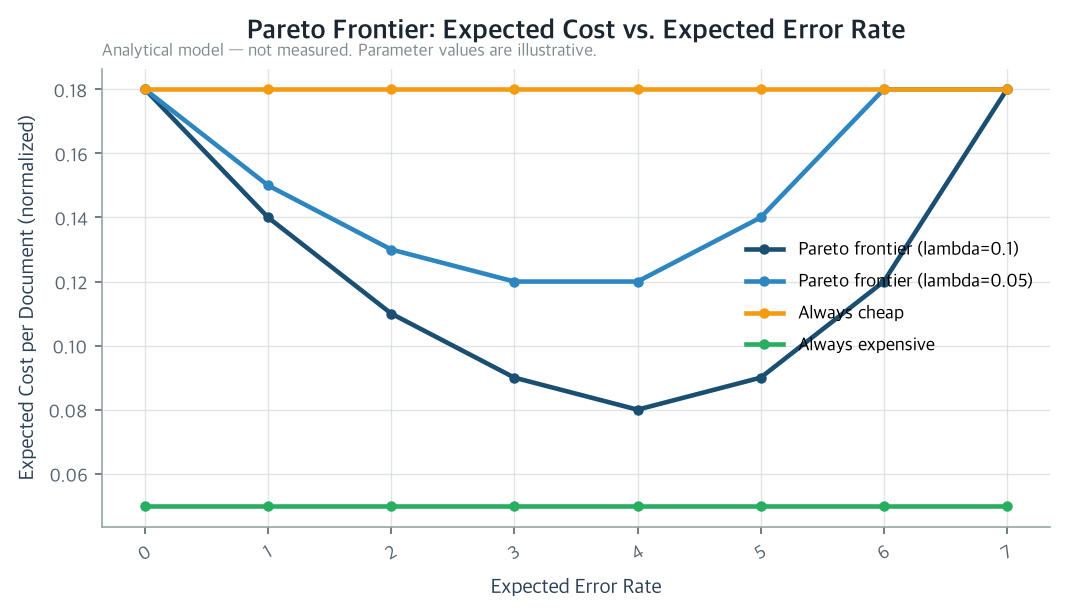 A conceptual diagram of how the confidence threshold τ traces the Pareto frontier between the always-cheap and always-expensive policies. This curve is derived from the paper’s analytical model rather than measured data, and the parameter values are illustrative.
Whether this frontier forms a smooth, concave curve hinges on a single assumption: that the cheap model’s confidence score can correctly rank how much benefit escalation would bring. The paper shows that when this assumption holds, the frontier takes the same concave shape already proven for text LLM cascades, but it also points out that this assumption is precisely the one most likely to break down in the situations where a cascade is most attractive. Low-resource scripts push the model to confidently produce wrong answers, perceptual confidence and inferential confidence get collapsed into a single scalar value, character-level confidence fails entirely to detect structural errors from broken tables or layout, and a threshold tuned on one document type drifts out of calibration the moment it’s moved to another type.
These four collapse into distinct failure modes, and among them the one the paper flags as most dangerous isn’t “low confidence but correct” but rather “high confidence but wrong.” When a cheap model encounters an unfamiliar script and produces a plausible, fluent, yet wrong result with high confidence, that document is never escalated. The cascade believes it handled the document well, while in fact it is quietly carrying the worst kind of error.
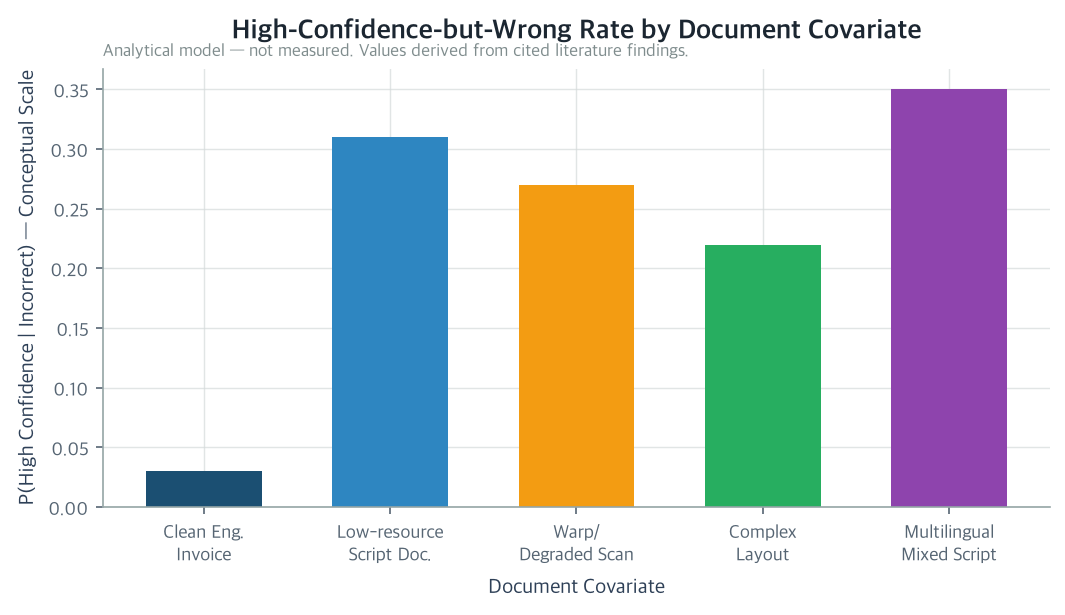 A conceptual diagram of how the rate of high-confidence-but-wrong outputs from the cheap VLM varies by document covariate. This is not measured data but a value derived from results reported in cited prior literature.
The paper doesn’t stop there. It also addresses which direction the cost-accuracy frontier itself shifts as the document population moves from clean English invoices toward low-resource scripts, degraded scans, and complex layouts. As scan quality degrades, the cheap model’s error rate rises, which widens the room for a cascade to exploit, but at the same time there is a risk that the region where errors concentrate overlaps with the region where the model’s confidence predictions themselves become unstable. On the language and script axis, the paper cites the GlotOCR benchmark’s finding that most VLMs work well on fewer than ten scripts, even the top model collapses past thirty scripts, and hallucination increases together with low-resource languages. On the layout complexity axis, it cites prior work showing that even high character-level accuracy can still be wrong at the whole-document level because of structural elements like tables, reading order, and watermarks.
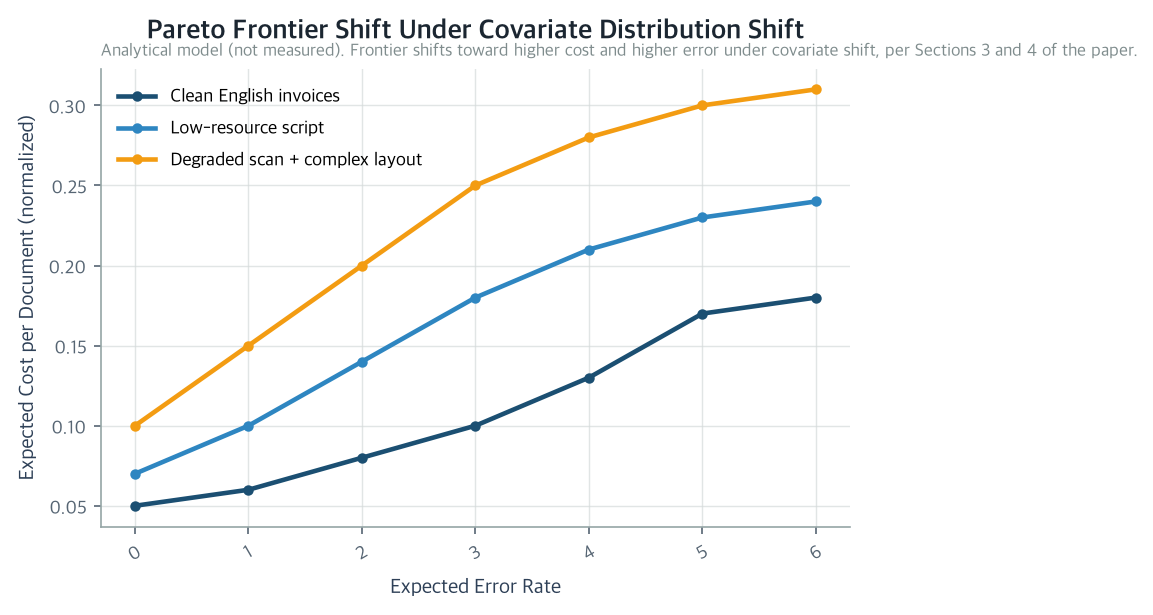 A conceptual diagram of how the cost-accuracy Pareto frontier shifts as the document population moves from clean English invoices toward low-resource scripts, low-quality scans, and complex layouts. This is a result derived from the analytical model rather than measured data.
Based on this analysis, the paper’s design guidance is clear. Don’t use a single global threshold across all documents; calibrate thresholds separately, at least coarsely, by script and scan quality. Design the confidence gate as a multi-signal system that looks at visual confidence and structural signals together rather than a single decoder probability. And in regions where both the cheap and expensive models wobble together, such as the most low-resource scripts, the honest choice is to skip the cascade entirely and either escalate everything or route to human review.
Contribution to the Company, Society, and Science
ThakiCloud’s AI platform document-parsing workloads already use PaddleOCR-VL-class models as the default path. The confidence threshold model this paper builds offers that workload a principled routing policy design space, instead of the binary choice between “always cheap” and “always expensive.” Viewed socially, the institutions and individuals who mainly handle low-resource-language or low-quality-scan documents are exactly the ones who should be able to access accurate document automation without the cost of constantly calling a large VLM, and this paper quantitatively pins down the paradox that it is precisely this group where a cascade’s confidence signal is most likely to break. In other words, it explicitly surfaces the point where a cost-reduction technique becomes least trustworthy for the very users who need it most. Scientifically, it extends the FrugalGPT-style cascade and routing cost optimization literature, already validated in the text LLM domain, into the multimodal VLM and document OCR domain, and it advances the field by leaving behind an organized taxonomy of failure modes for exactly which conditions (script, scan quality, layout) break confidence calibration.
Limitations
As the paper itself states, this is an analytical, position-taking piece of research, not an empirical one. The authors had planned to actually implement and measure the cascade, but that execution failed at the infrastructure provisioning stage, and as a result not a single measured accuracy, latency, cost, or benchmark number from the authors themselves appears in the paper. Every quantitative claim in the paper is one of two things: a property mathematically derived from the analytical model, or a result carried over directly from cited prior work. The authors themselves lay out specifically what follow-up research must measure. A calibration curve needs to be drawn between the cheap model’s confidence and actual correctness, across document sets split by scan quality, language, and layout; it must be verified whether the actual cost-error points reached at various thresholds follow the concave frontier the paper predicts or collapse instead; and how much a threshold tuned on one document population drifts when moved to another population also needs to be quantified. The paper also covers only a two-stage cascade using a single scalar threshold, and does not address the frontier shape for multi-stage cascades, learned routers, or clustering-based designs.
The paper’s detail page can be found at the following link: https://huggingface.co/datasets/thaki-AI/daily-paper-2026-07-14-confidence-gated-ocr-vlm-cascade