Automating PhD-Grade Research with the STORM Method: A 4-Step Knowledge Curation Workflow
Research is time-consuming work. To dig into a topic properly, you have to formulate questions, gather material from several angles, build a structure, and then write a result with citations attached. STORM (Synthesis of Topic Outlines through Retrieval and Multi-perspective question asking), released by Stanford’s OVAL Lab, is a knowledge-curation system that automates this process with an LLM. It was presented at NAACL 2024, and its goal is to generate Wikipedia-grade long-form articles, complete with citations, from scratch.
At ThakiCloud, we operate a K8s-based AI/ML SaaS platform and have worked hands-on with multi-agent knowledge-work workflows. Below we look at how STORM’s design ports onto a practical pipeline, and why it is structurally better than a plain “just summarize this” prompt.
The core of STORM: the pre-writing stage creates the quality
Most LLM writing is “give it a topic and it writes the body immediately.” What makes STORM different is that it concentrates on the pre-writing stage. It emulates what a human expert does before they start writing.
STORM’s pipeline has two broad stages.
- Multi-perspective question generation + outline writing: it looks at the topic from several personas (perspectives), generates questions, gathers evidence for each question through search, and then synthesizes the results into a hierarchical outline.
- Outline-based body writing: following the outline it has built, it fills in the body section by section and links the retrieved evidence as citations.
The key insight is “asking from multiple perspectives.” Questioning from a single perspective leaves blind spots, but when several personas ask from their own concerns, coverage widens. This is exactly the same pattern as verifying one problem through different lenses in a multi-agent system.
Porting it into a 4-prompt workflow
Even without running the entire STORM codebase (stanford-oval/storm), you can port the skeleton of the method into a 4-step prompt workflow. The key is “not making it do everything at once, but separating the stages.”
- Step 1, perspective discovery: have it pull out 3 to 5 different stakeholder/expert personas for the topic. State explicitly what each persona is most curious about.
- Step 2, multi-perspective questions: generate concrete questions from each persona’s viewpoint, and collect searchable evidence for each question (wired to web search / document ingestion).
- Step 3, outline synthesis: synthesize the collected evidence into a hierarchical outline. At this point, remove duplication and settle the logical order.
- Step 4, cited body writing: write the body following the outline, but link every claim to evidence.
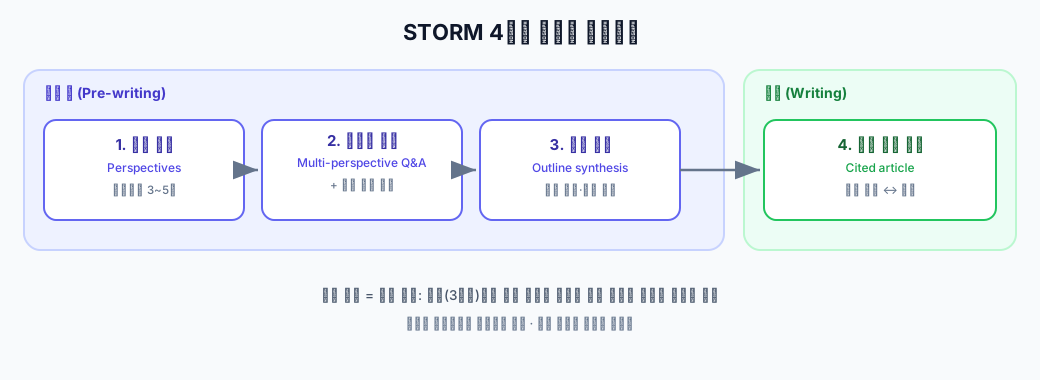
Separating the stages lets you verify the intermediate products. If the outline is sloppy, the body will be sloppy too, so stopping at Step 3 and fixing it is far cheaper than throwing away the entire Step 4 result.
Practical value from a data scientist’s viewpoint
There are three reasons STORM is useful as a method, not just a prompt tip.
- Stage separation is the verification point: a decomposed pipeline lets you measure quality at each stage. When you evaluate a research agent, you should look at “question coverage,” “evidence citation rate,” and “outline consistency” stage by stage, rather than a single line of final-report quality. That is how the bottleneck becomes visible.
- Multi-perspective = the coverage engine: diversifying the perspectives you question from is more effective at filling gaps than simply running more searches. This matches the practical experience that the real diversity engine is the variety of query strategies, not the number of search tools.
- Forcing citations reduces hallucination: tying every claim to retrieved evidence reduces the room for the model to make things up. That said, whether the evidence URL is actually reachable has to be verified in code. A separate guard is needed to keep the model from fabricating citations.
ThakiCloud’s view: treating knowledge workflows as infrastructure
We work on running these multi-stage research pipelines reproducibly on K8s. By separating each stage into an independent job, you can route search, synthesis, and writing to different model tiers: exploration to a cheap model, synthesis and judgment to a strong model. This design that separates cost from quality is the core of multi-agent knowledge work.
STORM’s message is clear. Good research automation comes not from a “smarter model” but from a “better pre-writing-stage design.” Before you write, ask, investigate, and build the structure. Then write.
Source: STORM (Synthesis of Topic Outlines through Retrieval and Multi-perspective question asking), Stanford OVAL Lab (NAACL 2024). GitHub: https://github.com/stanford-oval/storm