Agents Take the Wheel on GPU Training: Dissecting NVIDIA Cosmos 3 Agent Skills
Last week, our design-system UI generation experiment led us to the conclusion that you need to build the gate before the model. NVIDIA’s newly published Cosmos 3 post-training case study is the other half of that story. Here, instead of a human hand-building the gate, encapsulated knowledge called an agent skill is handed to a coding agent, and that agent drives fine-tuning, evaluation, and hyperparameter search on its own. The intended audience is ML and platform engineers who want to post-train foundation models on their own infrastructure. To cut to the conclusion: the real protagonist of this case study is neither the model nor the GPUs, but the harness that hardens workflow knowledge into a skill and lets an agent run it repeatedly.
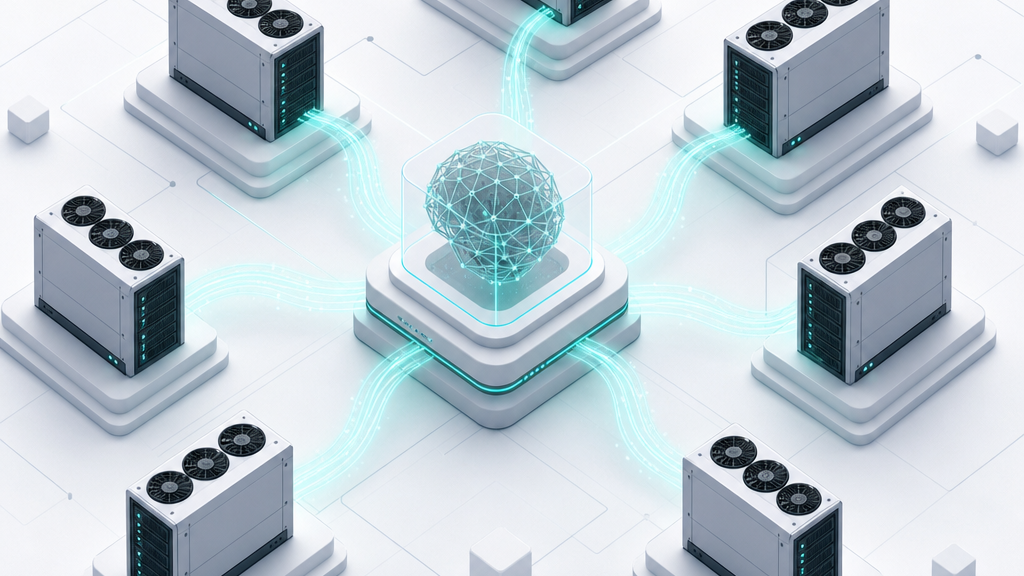 Agent skills conduct the repetitive labor of GPU training, evaluation, and tuning. The human only supplies the goal through a prompt.
What Cosmos 3 and Agent Skills Are
Cosmos 3 is a foundation model NVIDIA built to handle the physical world. It uses a Mixture-of-Transformers architecture that unifies text, images, video, ambient sound, and motion tracking, combining an autoregressive reasoning tower responsible for logic and planning with a diffusion transformer that predicts future states. NVIDIA states that this model ranks first on multiple benchmarks including VANTAGE-Bench, PAI-Bench, Physics-IQ, RoboLab, and RoboArena. It comes in two sizes, the 64B Cosmos 3 Super and the 16B Cosmos 3 Nano, and this case study uses Nano.
The key here is not the model but the TAO agent skill attached alongside it. A TAO agent skill is a bundle of knowledge that automates the post-training workflow for vision models. It encapsulates task-specific knowledge such as framework details, launcher behavior, config structure, data loading conventions, and evaluation workflows, so that a coding agent like Codex or Claude can orchestrate a training pipeline on its own with minimal human intervention. In other words, a skill is not a single-line prompt but a reusable unit that packages an executable procedure together with failure recovery.
Post-Training That Finishes with Two Prompts
What makes this case study striking is that the only human input was two natural-language prompts.
The first prompt instructs LoRA post-training. It asks the agent to train
nvidia/Cosmos3-Nano with LoRA on Toyota’s Woven Traffic Safety dataset, but to run a baseline
evaluation first for comparison.
Perform LoRA post-training of the Cosmos 3 model on the Woven Traffic
Safety dataset. Training data: /home/.../WTS_dataset/wts_data_train
Validation data: /home/.../WTS_dataset/wts_data_val
Base model on Hugging Face: nvidia/Cosmos3-Nano
Also perform a baseline evaluation first, to compare with the post-trained model.
With this single prompt, the agent handled several tasks in sequence. It found and patched a missing FPS parameter in the data pipeline on its own, cached the model using a Hugging Face token, measured a pre-training zero-shot baseline of 54.41%, and then ran LoRA training. What stands out here is the instruction to “run a baseline evaluation first.” Instead of trusting a self-reported result after training, the agent pinned down a pre-training number as a measured baseline and actually measured the improvement. This is exactly the same principle we learned from our experiment last week.
The second prompt is an AutoML sweep. It leaves the search strategy and which hyperparameters to tune up to TAO, and asks the agent to optimize validation accuracy and summarize the best models.
Run an AutoML sweep to improve the LoRA result. Let TAO choose suitable
search strategies and tune the important training hyperparameters. Optimize
validation accuracy and summarize the best models.
Looking at the overall flow as a diagram, the human appears only at both ends, while the skill fills in the repetitive work in between.
flowchart TB
    A["Natural-language prompt<br/>(LoRA training + baseline eval)"] --> B["Coding agent<br/>(Codex / Claude)"]
    B --> C["TAO agent skill<br/>encapsulates framework, launcher, config,<br/>data loading, and evaluation knowledge"]
    C --> D["Automatic error patching<br/>(fixing missing FPS parameter)"]
    C --> E["Model caching<br/>(Cosmos3-Nano via HF token)"]
    C --> F["Baseline evaluation<br/>(zero-shot 54.41%)"]
    F --> G["LoRA post-training<br/>(8x A100, ~30 min/epoch)"]
    G --> H["AutoML sweep<br/>(43 parallel trials, 19.5 hours)"]
    H --> I["Serving the best adapter<br/>Cosmos 3 Reasoner NIM<br/>(OpenAI-compatible endpoint)"]
Environment setup is three tokens and one install script line. Set HUGGINGFACE_TOKEN,
NGC_API_KEY, and AUTOML_LLM_API_KEY in the terminal, then install the agent skill with the
script below.
export HUGGINGFACE_TOKEN="your_hf_token"
export NGC_API_KEY="your_ngc_key"
export AUTOML_LLM_API_KEY="your_llm_key"

curl -fsSL https://raw.githubusercontent.com/NVIDIA-TAO/tao-skills-bank/main/scripts/install-codex-agents.sh | bash
The training data is Toyota’s Woven Traffic Safety dataset, a video question-answering task with over 8,000 training and validation samples. It consists of four-choice questions about road structure, road type, and traffic safety situations.
The Numbers Two Prompts Produced
Performance improved clearly. All the figures below are values NVIDIA published, not results we reproduced.
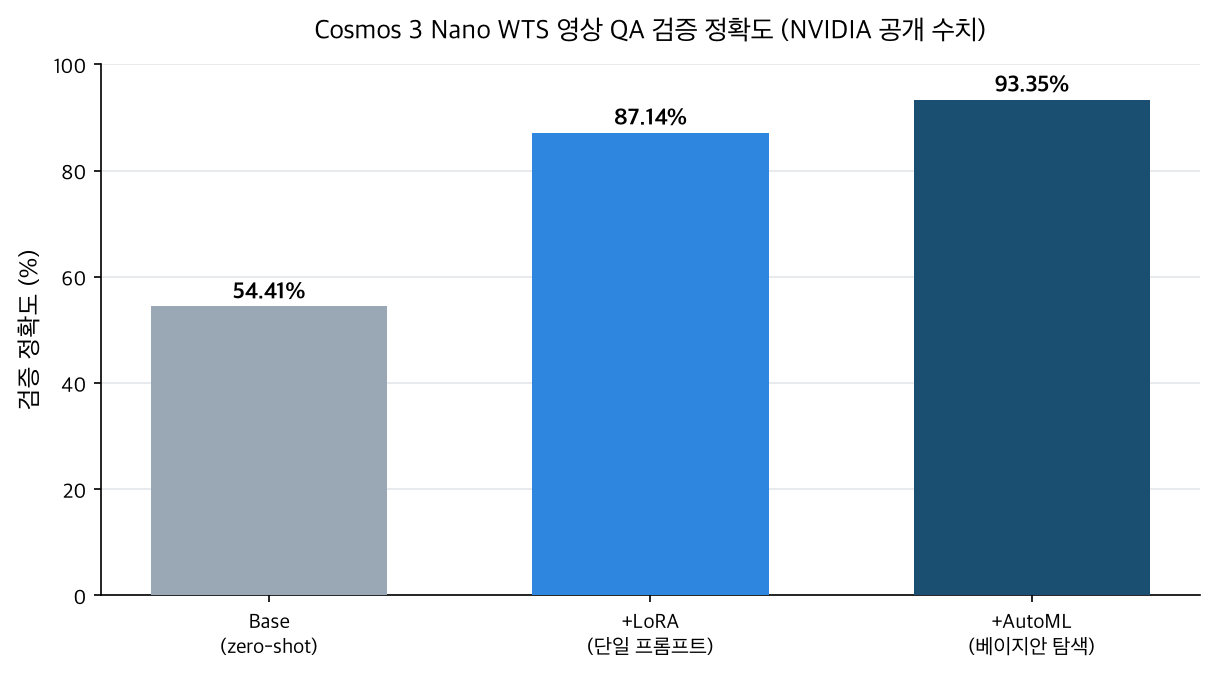 Two prompts raised validation accuracy from 54.41% to 93.35%. NVIDIA published figures.
The zero-shot baseline was 54.41%, and the single-prompt LoRA run raised it by 32.73 points to 87.14%. On top of that, the AutoML sweep tuned hyperparameters with Bayesian optimization and pushed it to 93.35%, a gain of 38.94 points over the baseline. The key point is that these numbers came without a human touching a single hyperparameter by hand; the agent chose the search strategy and ran the repeated training itself.
To be honest about it, we also need to look at the cost numbers. LoRA training took about 30 minutes per epoch on 8x A100 80GB GPUs, and the AutoML sweep ran 43 trials in parallel across multiple A100 nodes, taking 19.5 hours. A full-parameter SFT run used as a comparison took 3h34m on H100, and NVIDIA states that LoRA cut GPU time to roughly one-seventh of that full SFT run. Once training finishes, Cosmos 3 Reasoner NIM serves the LoRA adapter through an OpenAI-compatible endpoint, a structure that deploys directly as a prebuilt microservice without requiring manual setup of vLLM dependencies or CUDA configuration.
Did We Run This Ourselves
To be honest, we did not reproduce this workflow in our own environment. The Cosmos 3 family of weights sits behind a gated Hugging Face repository, it requires 8 A100 GPUs plus NGC and AutoML LLM keys, and the parallel sweep used in the case study assumes multiple GPU nodes. We did not secure this combination of resources for this post. So every number above is a quote of a value NVIDIA published, and we do not present it as something we measured ourselves. We hold to the principle of never fabricating a benchmark without reproducing it. What we can do instead is dissect the structure of this case study and precisely contrast it with what is already running on our own platform, noting what matches and what differs.
Implications for ThakiCloud Products
This case study is a rare topic where the perspectives of both our products interlock.
From the Paxis lens, this is external validation of our thesis that skills should be treated as first-class resources. Paxis is ThakiCloud’s Agent-Native Cloud control plane, and it treats Skills, Tools, Policies, and Audit Logs as first-class resources. The Skill Harness selects from over 960 skills using BM25, runs them in an isolated sandbox, and routes every action through policy gates and audit logs. What NVIDIA’s TAO agent skill proves is that when a skill encapsulates framework details all the way down to failure recovery, a coding agent can reliably repeat a complex workflow. This is exactly the direction we have been defining skills in: not as prompts, but as units of execution. The difference is just as clear, though. TAO skills are tightly bound to the NVIDIA stack, so they are hard to use as-is outside the TAO launcher, Cosmos models, NGC, and NIM. The Paxis skill harness is designed to avoid dependency on any specific vendor or model, and that is exactly the core of the value we aim to deliver in on-premises and sovereign environments.
From the ai-platform lens, this is exactly the GPU training and serving we schedule every day. Throwing 43 AutoML trials in parallel across multiple nodes directly overlaps with how Kueue manages the GPU queue on our platform. NIM serving a LoRA adapter through an OpenAI-compatible endpoint solves the same problem our vLLM serving path solves. And the fact that LoRA cuts GPU time substantially compared to full SFT supports our thesis that low-cost serving and low-cost training are ultimately what make agent economics work. When a customer wants to post-train a foundation model on their own data, we offer a path where they slice GPUs with Kueue and serve adapters with vLLM on their own cluster, rather than going through a gated external cloud.
Put the two lenses together and the picture is complete. ai-platform underpins low-cost training and serving, and on top of that Paxis drives the agent with skills, policies, and audit. NVIDIA’s case study, using someone else’s benchmark, shows that this combination actually leads to real performance gains.
Limits and Counterarguments
To avoid overstating this case study, four things need to be kept in view together. First, “in one day” is a wall-clock measure, not a GPU-time measure. A 19.5-hour sweep across 8 A100 GPUs and multiple nodes is by no means cheap, and one-seventh is a relative figure against full SFT, not a claim of absolute cheapness. Second, 93.35% is a number from a narrow task: four-choice traffic-safety video QA. It should not be inflated into a claim that general physical reasoning ability improved by that much. Third, automation hides vendor lock-in. The reason the agent could patch errors “on its own” is that the skill bank already knew that exact framework’s error patterns in advance. That smoothness disappears once you step outside the stack. Fourth, “minimal intervention” is not zero intervention. A human still has to enter API keys, specify dataset paths, and install a skill bank suited to that task in the first place before the flow can begin. What the agent removed is repetitive labor, not judgment itself.
Even so, the direction is clear. Hardening workflow knowledge into a skill, having an agent execute that skill repeatedly, and confirming improvement through a measured gate rather than a self-report is not one vendor’s strategy but a common design pattern of the agent era. That structure is exactly what we are building with Paxis and ai-platform.
Sources
- NVIDIA Developer Blog, “Post-Train NVIDIA Cosmos 3 in One Day Using Agent Skills” (https://developer.nvidia.com/blog/post-train-nvidia-cosmos-3-in-one-day-using-agent-skills/)
- GitHub: NVIDIA/cosmos, NVIDIA-TAO/tao-skill-bank
- Hugging Face: nvidia/Cosmos3-Nano, nvidia/Cosmos3-Super
- Dataset: Woven Traffic Safety (WTS), Toyota