When Software Becomes Free, What Do Engineers Do? Dario Amodei’s Prophecy
The Moment the Switch Flips
At the World Economic Forum in Davos in January 2026, Anthropic CEO Dario Amodei dropped a short sentence during a conversation with WSJ Editor-in-Chief Emma Tucker.
Software is “going to become cheap,” he said, and “maybe essentially free.” The foundational premise of SaaS, recover development costs by distributing them across millions of users, might no longer hold.
(Original quote: “Software is going to become cheap, maybe essentially free”, WSJ/Davos interview, January 2026)
The model of hiring dozens of engineers, building a product over years, and selling it to millions of users: that economic foundation, he warned, could be shaking.
In the same conversation, Amodei said something else. AI would compress 100 years of economic change into 5 to 10 years, and the disruption could be “unusually painful.” (CNBC, January 27, 2026)
The future of engineering teams hangs between those two statements.
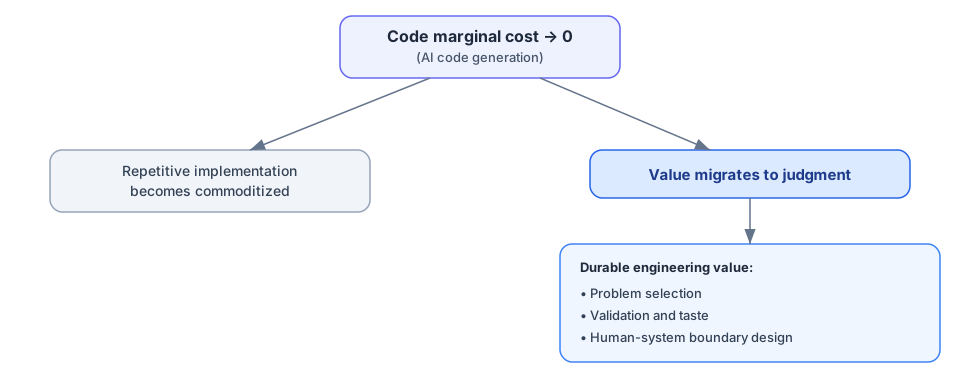
Where engineering value migrates as code’s marginal cost approaches zero
What Happens When Marginal Cost Approaches Zero
In economics, marginal cost is the cost of producing one additional unit. The software industry has long benefited from the near-zero cost of copying digital products, write code once, replicate it millions of times at no additional cost.
What Amodei is describing is the next step: what happens when the cost of creating software itself approaches zero.
The signs are already here. Tools like GitHub Copilot, Cursor, and Claude Code are rapidly lowering the cost of code generation. Scaffolding CRUD apps, writing tests, extracting documentation, repetitive tasks are getting cheaper by the day.
When those costs converge toward zero, where does the competitive advantage of what engineers build remain?
Not in the ability to write code. In the ability to judge what to write. That is where it remains.
Why Did Amodei’s Position Change?
It is worth noting that Amodei’s own statements shifted significantly in just a few months.
In a January 2026 CNBC essay, he warned that the job disruption would be “unusually painful.” Then in May 2026, ahead of Anthropic’s IPO, he shifted his emphasis toward “augmentation.” Fortune reported this shift as a move toward “walking back” his AI jobs apocalypse prophecies. (Fortune, May 26, 2026)
The two statements are not contradictory, they must be read together. Pain will come in the short term; roles will be redefined over the medium and long term. But that redefinition will not happen on its own. That is the point.
In the May interview, he also said: “there are jobs that took generations to build that may disappear.” This was not a warning about individual jobs but about the structure of careers, entire professional lineages that could cease to exist.
This is not the fear scenario where “all developers become unnecessary.” It is a more uncomfortable story. The half-life of expertise accumulated so far is shortening dramatically.
What Disappears and What Remains
When the marginal cost of software falls, what is threatened first is repetitive implementation work. Translating known patterns into code, combining existing components, implementing specs verbatim, AI tools handle these tasks increasingly well.
Even as code-generation costs fall, some value does not disappear. Three categories stand out.
The ability to choose the right problem. Knowing what to build is far harder than knowing how to build it. Catching the gap between what users say and what they actually want, choosing from among hundreds of candidate features the one that must be built right now, these judgments are hard for algorithms to replace. The lower the cost of building, the greater the relative weight of deciding what to build.
Validation and taste. As AI-generated code proliferates, the ability to judge whether it is correct becomes a core competency. Not simply bug detection. Will this design still be maintainable six months from now? Does this API behave predictably? Does this codebase reduce the team’s cognitive load? These are products of taste and experience that only a seasoned engineer possesses.
Human-system boundary design. Distinguishing what AI cannot automate from what it should automate, and designing how humans intervene at that boundary. Just as the expansion of autonomous driving makes the design of driver-intervention moments more important, as AI writes more code, the role of designing where humans must exercise judgment grows more critical.
What Happens Economically
When the supply curve of software shifts downward, something paradoxical occurs.
More supply lowers prices. Lower prices cause demand to explode. Problems that were previously too expensive to solve with software become feasible, patient management for small clinics, inventory optimization for a neighborhood restaurant, data analysis pipelines for individual researchers.
Engineering demand does not shrink; its structure changes. Positions focused on repetitive implementation inside large software companies may contract. In their place, demand grows for roles that use AI to solve real problems across countless domains.
Amodei’s point about the SaaS “millions-of-users distribution model” cracking fits the same logic. Software companies have historically achieved economic viability by recovering development costs across many users. If the cost of building software approaches zero, there is less reason to build generic solutions for millions. Customized software for a specific organization, a specific team, even a specific individual becomes economically viable.
The beneficiaries of this shift are domain experts. Physicians, lawyers, accountants, logistics specialists, people who deeply understand their own work will be able to build their own software using AI tools. Engineers’ roles move toward collaborating with these experts to handle what AI tools struggle to produce: design, validation, and integration.
The transition will be painful. When Amodei said in January that it would be “unusually painful,” he was speaking about the speed of the transition. If the Industrial Revolution unfolded over decades, this one could happen in a few years. There may not be enough time for retraining.
It is also worth noting that Amodei did not walk back his warning. Even as he softened his tone in May, he also said, in the same period, “there are jobs that took generations to build that may disappear.” The tension between these two statements must be confronted directly. The possibility of augmentation and the fundamental disruption of career structures are not contradictory, both can be simultaneously true.
What Changes for Engineering Teams and Organizations
This is not only a personal matter; it is also a question of how organizations should be structured.
Role boundaries blur. Product managers, data analysts, and domain experts emerge who can build prototypes using AI tools without writing code directly. Engineers must understand business context more deeply and collaborate more closely with domain experts. The definition of “engineers just need to write good code” is no longer stable.
Validation culture matters more. Organizations that push AI-generated code directly to production may move fast in the short term but become fragile over time. The ability to validate becomes more of a competitive advantage than the speed of generation. Code review must be a substantive act of judgment, not a procedural formality.
Problem definition becomes a core competency. The ability to build prototypes quickly means, paradoxically, that the decision of what to build must be made more carefully. The lower the cost of building, the greater the risk of building the wrong thing. Investment in user interviews, problem discovery, and hypothesis validation must increase.
The basis of trust changes. The standard shifts from who writes more code faster to who can define and validate better problems. This does not mean senior engineers’ value falls, it means that value must now be expressed in a different form.
ThakiCloud’s Perspective: What Infrastructure Tells Us
ThakiCloud builds AI-based software development infrastructure. If Amodei’s prophecy is correct, the meaning of what we build changes too.
Just because the marginal cost of software falls does not mean the marginal cost of infrastructure falls. GPUs, multi-tenancy, data governance, security, availability, AI tools do not generate these. As the number of AI-built software applications explodes, demand for the infrastructure that runs them grows in parallel.
For our team, Amodei’s remarks are both a warning and a direction. Warning: some things that have been valuable until now will rapidly lose value. Direction: if your value has come from repetitive implementation, you must move toward judgment and design.
Conclusion: When the Half-Life of Expertise Shortens
Software becoming free does not mean the people who make software become free. The cost of generating code falls; the value of the judgment required to build good software does not.
Amodei’s shift in emphasis between January and May is readable in this light. The disruption AI brings is real. On the other side of that disruption lies a different role.
The core quality of that role is one thing: the ability to judge what should be built and why. That is something a code editor cannot tell you.
The identity of an engineer is moving from “someone who writes code” to “someone who sees problems.” The gap between teams that recognize and prepare for that shift, and those that do not, will become visible within a few years.
Sources
- Dario Amodei / Anthropic, WSJ-Davos interview, January 2026, “Software will become essentially free”: The News.com.pk coverage
- Dario Amodei, CNBC, January 27, 2026, “unusually painful” job disruption warning: CNBC original
- Dario Amodei, May 2026 interview, “there are jobs that took generations to build that may disappear”: X @AnatoliKopadze RT (2026-05-26)
- Fortune, May 26, 2026, Amodei’s softened position: Fortune original