If AI Were the Best Decision-Maker: A Culture Where Data Beats Intuition
“The Best Stock Picker Who Never Picks Stocks”
In the spring of 2026, an intriguing assessment began circulating in the tech investor community: “Jensen Huang might be the best stock picker on Wall Street, even though he never picks stocks himself.” This was not a statement Huang made. It was a label attached by market observers.
The evidence was specific. Companies Huang mentioned in public appearances and keynotes, Nebius (+840%), Applied Digital (+1,400%), TSMC (+135%), Micron (+770%), surged after his remarks. He never once said “buy this company,” yet the moves happened.
Why does this story speak to decision-making culture? Huang’s words moved markets not because of luck or some special intuition. He was reading the data flows of the AI ecosystem, chip demand, cloud infrastructure investment, the beneficiary structure at the software layer, in an unusually systematic way. What looked like intuition was the judgment of someone who structures data rigorously.
That is the starting point for this article. The substance behind seemingly intuitive, outstanding judgment is data structuring.
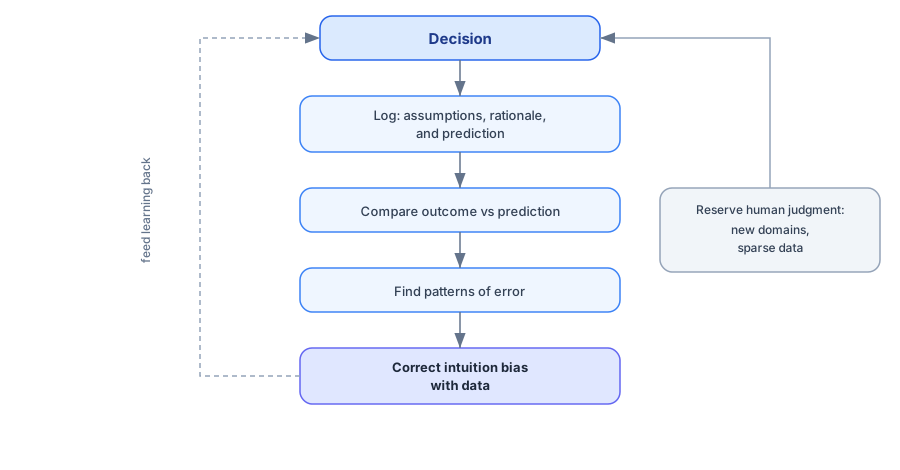
Logging decisions and comparing them to predictions, so data can correct intuition bias
Inheriting Moneyball: Is the Age of Intuition Over?
In our previous post (Building a Data-Driven Organizational Culture with Moneyball Thinking), we told the story of the 2002 Oakland Athletics. Billy Beane unearthed the undervalued metric of on-base percentage and produced 103 wins on one-third of a typical payroll.
That post rested on two core propositions: the metrics you have been using may be wrong; and undervalued resources found through data yield maximum efficiency.
In the age of AI, these propositions return as a much sharper question: how much room is left for intuition?
In baseball, a scout’s experience and eye were the gold standard of evaluation for decades. They were not wrong. But data controlled for more variables and produced better predictions. Decision quality was better explained by the quantity and structuring capacity of available data than by human experience.
Organizations in the AI era face this structural shift even more fundamentally. Models process thousands of variables simultaneously, discover patterns, and reduce their own prediction error. The traditional strengths of intuition, accumulated experience, pattern recognition, rapid judgment, are precisely the areas where AI is pulling ahead.
So how should an organization’s decision-making structure change?
Instrument Your Decisions: Turning Choices into Data
The core of Moneyball thinking is not changing performance metrics. It is making decisions themselves measurable.
The Oakland A’s chose on-base percentage not merely because they believed it was a more important metric. They proved the causal relationship between runs scored and OBP with numbers. Because the link between the metric and the outcome was data-backed, they could execute that judgment repeatedly.
Organizational decision-making follows the same structure.
How Do You Tell a Good Decision from a Bad One?
In most organizations, decision quality is reverse-engineered from outcomes. Things went well, good decision; things went badly, bad decision. But this approach carries two problems.
Good decisions can produce bad outcomes. Even when you decide as well as possible with the information available, external variables can defy your predictions. When you judge a decision by its result, hindsight bias, constructing a story after the fact to fit what happened, blocks organizational learning.
Bad decisions can produce good outcomes. This is even more dangerous. When baseless intuition happens to be correct, you start trusting that intuition, and it eventually leads to the next failure.
A data-driven decision culture begins by recording and evaluating the basis for a decision at the time it is made, not by the result.
The Decision Log: An Audit Trail for Judgment
The starting point is to explicitly record three things at the moment of decision:
- What are the assumptions underlying this decision?
- What data supports those assumptions?
- How will we know if this decision is wrong? (the falsification condition)
The third question is critical. “This feature will raise retention by 5%” is unverifiable as stated. But write it as: “If seven-day retention has not risen by at least 5% within eight weeks of launch, this assumption is wrong”, and the decision becomes measurable.
At GTC Taipei 2026, NVIDIA disclosed a model that allocates a portion of engineers’ base salaries as a token budget to measure productivity. This is not merely a change in compensation structure. It is a declaration to actually measure the outcomes of decisions about AI tool adoption. Organizations can only learn when decisions can be tracked numerically.
Where Intuition Wins: The Limits of Data
The claim that data-driven decision-making replaces intuition is only half right. There are domains where data does better, and domains where intuition is still needed.
Where Data Is Strong
In decisions where repeatable patterns exist, data overwhelms intuition.
- Predictions with sufficient history (conversion rates, churn rates, demand forecasting)
- Experiments with clear success metrics (A/B tests, feature flags)
- Extracting signals from large-scale data (user segmentation, anomaly detection)
In these areas, intuition does not beat data. Even an experienced PM saying “users will love this feature” turns out to be wrong far more often than expected once you run the experiment. A finding commonly reported across large tech companies’ A/B testing experience is that features considered “certain wins” internally frequently fail to perform as well as hoped in actual experiments.
Where Intuition Is Still Needed
The domain where data is weak is situations without precedent.
New markets, new technology paradigms, early-stage decisions where data has not yet accumulated, in these situations there is simply no data from which patterns can be learned. The Oakland A’s could surface on-base percentage because decades of baseball records existed. If it were an entirely new sport, you would have to invent the concept of on-base percentage itself.
Here, intuition’s role is to set the direction of data collection. Deciding “what data should we gather?” remains a human judgment. Huang’s ability to read the flow of AI infrastructure demand came from decades of direct experience in the semiconductor and software ecosystem. When that judgment is validated by data, it becomes “systematic insight that looks like intuition.”
The Data Theater Trap
There is one more pitfall to guard against. The pattern of appearing to use data while actually selecting data to justify a conclusion already reached, this is called “data theater.”
The symptoms look like this. A decision is made first. Then only the data supporting that decision appears in the report. Contradicting data is excluded on grounds that “the context is different” or “the sample is too small.” The form is data-driven; in substance it is intuition with a data wrapper.
There is a reason data theater is more dangerous than pure intuition. When intuition is wrong, you can admit “my judgment was wrong.” When data theater is wrong, it leads to the defense “the data we looked at was faulty,” and learning is blocked.
The Conditions Under Which Data Beats Intuition in an Organization
Even with good data, an organization’s decisions often do not change. Data beating intuition is not a technology problem, it is a culture and structure problem.
Condition 1: Falsification Must Be Safe
You need an environment where it is possible to say “this data refutes our hypothesis.”
In many organizations, when an experiment shows that a feature proposed by an executive is ineffective, it is difficult to report that result as-is. Hierarchical structure distorts data. When a leader first demonstrates that “my hypothesis could be wrong,” the rest of the organization follows.
Amazon’s “disagree and commit” culture addresses exactly this point. Executing a decision you disagree with, and continuing to validate it with data while executing it, are not contradictions. When these two things work together, data becomes meaningful.
Condition 2: The Unit of Decision Must Be Small
In a structure where big decisions are made all at once, it is hard for data to influence decision-making. A company that sets its roadmap every six months cannot easily change direction even when data comes in mid-cycle.
Breaking decisions down is the practical structure of a data-driven culture. “Should we spend three months developing this feature?” is a worse question than “Can we validate the core assumption with a two-week prototype?” Small decisions enable rapid learning and allow data to actually change direction.
The proposition we raised in the Moneyball article, “a team that takes three weeks to run an A/B test versus one that takes three days will have ten times the learning one year later”, goes deeper here. The difference in learning speed is not a difference in the amount of data; it is a difference in the size and frequency of the decision unit.
Condition 3: Past Decisions Must Be Traceable
You must be able to answer “why did it turn out this way?”
In many organizations, the reasoning behind important decisions disappears. The people in the room at the time leave the company; Slack channels get archived; the data from that moment was never saved. New team members see only the outcome of a decision and cannot know why it was made.
When decision logs become as natural a practice as code review, an organization can learn from its own patterns of judgment. What kinds of decisions do we get wrong repeatedly? What assumptions keep collapsing? When these become visible, you can use data to correct the biases of intuition.
AI Agents and the Changing Structure of Decision-Making
At GTC Taipei 2026, Huang said “every engineer is going to have and manage hundreds of agents.” This is not simply a change in tools. It is a change in the very structure of decision-making.
When agents handle repetitive and pattern-based tasks, the domain where human judgment needs to concentrate shifts. Distinguishing between decisions that can be delegated to agents and decisions that humans must make directly, this distinction itself becomes a new core competency.
Adopting agents is not the completion of a data-driven decision culture. Rather, the more important question is how humans audit and validate the premises and outcomes of the decisions agents make. Agents also make biased decisions when trained on biased data. For agent decisions too, you must ask: “What are the premises of this decision? What are the falsification conditions?”
Just as Paul DePodesta built statistical models in Moneyball, organizations that operate agents must explicitly design which decisions are delegated to agents and on what basis those decisions are trusted.
Implications for Organizations: Three Actionable Steps
A data-driven decision culture is not about building more dashboards. It is about changing the structure of decisions.
First, write down the falsification conditions for a decision in advance. Before launching a feature, the team agrees together on what data would mean the decision was wrong. Narrowing the room for interpretation before the results come in is the most practical way to prevent data theater.
Second, turn wrong decisions into learning assets. Failed experiments should not disappear, they must remain accessible to the whole team. A post-mortem that documents “why did this feature not work?” becomes an input to the next planning cycle. Past failures correct future intuition.
Third, design agent decisions so they are auditable. There needs to be a structure in which it is possible to explain after the fact “on what data did this agent make what judgment?” The moment an agent’s reasoning becomes a black box, that organization has ceased to be data-driven and has regressed to agent-based intuition.
ThakiCloud’s work building a Kueue-based agent scheduling infrastructure can be read in this context. How agents distribute workloads, and whether the reasoning behind those decisions is preserved in logs, this is the foundation of platform trust.
Conclusion: Intuition Does Not Disappear, It Just Finds a New Place
The question “if AI were the best decision-maker” starts from a false premise. There are decisions where AI and data do better, and decisions where human experience and judgment do better. What matters is not which is superior overall, but designing who makes each decision based on the nature of that decision.
Billy Beane of Moneyball did not discard the scouts’ intuition. Human judgment was still needed for what data could not explain, a player’s mentality, team chemistry, positioning in a new market. What he built was not “an organization that eliminated intuition” but “an organization that was clear about where intuition should intervene.”
The reason Huang came to be called “the best stock picker” in the market is not that he lacks intuition. It is that decades of reading the semiconductor ecosystem through data accumulated, making his judgment look like pattern recognition. Ultimately, outstanding intuition is the product of long-term data structuring.
A decision culture where data beats intuition is one that creates a loop in an organization, a loop that starts with data and in which intuition reflects and revises itself. Organizations that keep that loop running continuously make better decisions over the long term.
Sources
- Jensen Huang, “Every engineer is going to have and manage hundreds of agents.”, NVIDIA GTC Taipei 2026 keynote, 2026-05-20 / 2026-06-01. NVIDIA official blog: https://blogs.nvidia.com/blog/nvidia-gtc-taipei-computex-2026-news/
- “Jensen Huang might be the best stock picker on Wall Street and he does not even pick stocks.”, External market-observer assessment (not a statement by Huang himself). @InTheAssembly X thread: https://x.com/InTheAssembly/status/2053801122632958342
- Jensen Huang, NVIDIA engineer token budget remarks, GTC Taipei Computex 2026 keynote transcript. Semiconalpha Substack: https://semiconalpha.substack.com/p/nvidia-keynote-computex-2026-key
- Nebius, Applied Digital, TSMC, Micron stock price data, @InTheAssembly X thread (same source as above)
- ThakiCloud blog, “Building a Data-Driven Organizational Culture with Moneyball Thinking” (the article this one continues): https://thakicloud.com/tech-blog/culture/moneyball-data-driven-culture/