Auditing an Autonomous Nightly Paper-Generation Pipeline Over 8 Days: A Case Study in Reliability, Diversity, and Research Integrity
This article will be useful if you operate, or are considering adopting, an autonomous agent pipeline that generates papers unattended every night, or if you are part of a team that cannot be fully confident an automation system is actually running reliably just by inspecting its final outputs. The paper introduced today is a case study in which the authors audit their own nightly autonomous paper-generation pipeline (nightly-paper-factory) using eight days of real operational logs. Rather than looking at the final papers themselves, they examine the gate pass records, topic duplication checks, and language purity flags generated along the way, and independently recompute the dashboard figures the pipeline itself reports from the raw logs.
The Problem: You Cannot Trust a Pipeline by Looking at Its Papers Alone
Fully autonomous LLM systems that discover a topic, research it, draft it, verify citations, and review themselves have moved beyond research demonstrations and into scheduled, unattended operation. The AI Scientist was the first system to systematically demonstrate this class of pipeline, and research on roadmaps, benchmarks, and multi-agent authoring frameworks has since grown quickly. What has grown far more slowly is the operational-audit literature. When these pipelines run unattended every night, we typically check only the finished paper and never look at the execution logs, gate pass results, or how topics are distributed over time. This is precisely the gap between a nightly cron job and a monitored production service, and the authors set out to close that gap for their own pipeline.
The question the paper asks is simple. When a fully autonomous nightly paper-generation pipeline is audited through its real operational logs, meaning its topic-deduplication verdicts, verification gate results, and keyword/domain distributions, how measurable are its reliability, topic diversity, and reproducibility, and what is the minimal set of guardrails needed to prevent quality degradation, duplication, and hallucination? The authors answer this not for a hypothetical system but for the one nightly-paper-factory pipeline they actually ran for eight days.
Core Contribution: An 8-Day Audit, Metric Recomputation, and One Clear Before/After Shift
The pipeline consists of five stages: generating candidate topics and checking them for novelty and duplication, drafting the paper, running experiments where possible against the organization’s own repositories and harness, verifying citations and data integrity, and finally a stage of final review and confirmation. Two guardrails are logged daily alongside this. One is a novelty gate that compares each candidate topic against a rolling window of prior topics and keywords and classifies it as pass, near-duplicate, or an upgrade of prior work. The other is a language purity guard that catches any non-English text leaking into the pipeline’s outputs anywhere. Whether this language flag checks precisely the final paper output, or also checks upstream orchestration metadata that a Korean-speaking operator might have written, cannot be determined from the log schema alone. The authors do not hide this ambiguity, and it turns out to matter for a later finding.
The clearest pattern across the eight days is a before/after shift centered on 2026-07-08. In the preceding three days (07-05 through 07-07), language purity is flagged false every time, completion rate stays at 0.6, and the pipeline never even reaches the review stage. In the four days that follow (07-09 through 07-12), language purity flips to true every time, completion rate hits 1.0, the pipeline reaches the review stage every time, every review is approved, and blocking issues stay at zero. The authors read this as strong circumstantial evidence that an operator deployed a guardrail fix around 07-08, and that this fix improved two independent reliability metrics, language purity and stage completion rate, at the same time. They are explicit, however, that this rests on an extremely small sample of three days before and four after, and they present it only as a descriptive contrast, not a statistical hypothesis test.
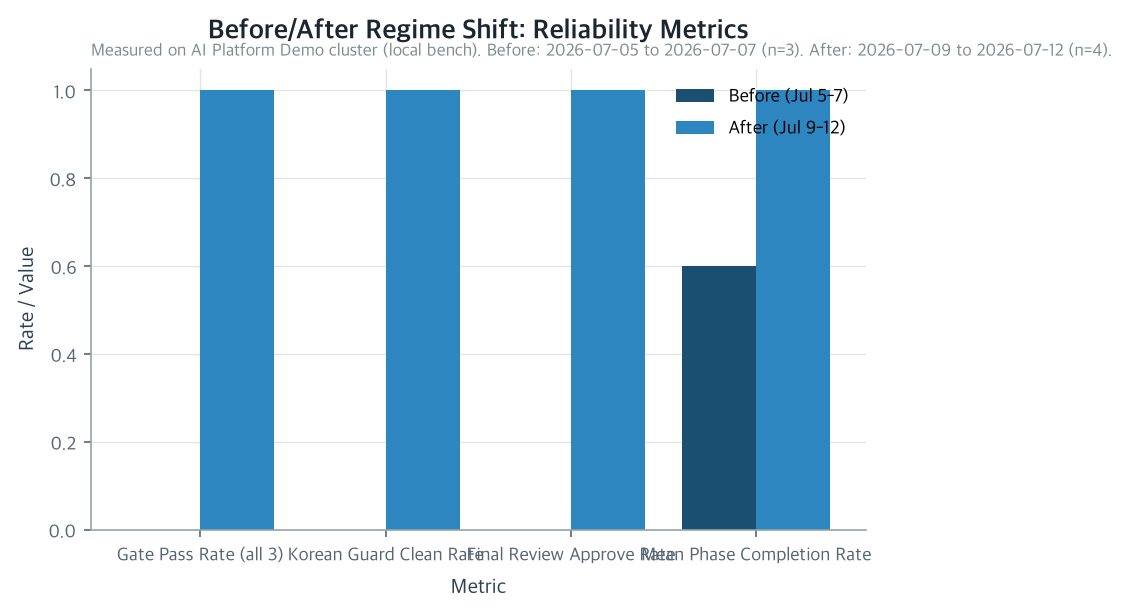 This figure shows language purity and stage completion rate improving together around 2026-07-08, based on the raw operational logs discussed in Sections 3 and 5 of the paper (before: 07-05 to 07-07, n=3; after: 07-09 to 07-12, n=4).
The paper also refuses to simply trust the composite metric the pipeline self-reports, gate_pass_rate_all3. Recomputing directly from the raw fields the proportion of days that satisfy all three conditions, novelty pass, language purity normal, and final review approval, the authors get 4/8=0.5, exactly matching the value the pipeline reported. This recomputation is itself presented as a methodological practice, leading to the general recommendation to never simply trust a single number shown on a dashboard and always recompute it from the raw logs. The record for the eighth day, 07-13, the very day this paper itself was being written, shows a completion rate of 0.2 with language purity flipping back to false. The authors leave this honestly unresolved, unable to distinguish between two possibilities: that the guardrail fix is not yet fully robust, or that the pipeline read a mid-run state before its own English-only finalization stage completed.
On the topic diversity side, only one of the seven keyword Jaccard similarity values between adjacent day pairs is nonzero. That value, 0.2308 between 07-09 and 07-10, occurred because both days covered skill-routing and search topics, and 07-10 was in fact a direct follow-up study that continued the research question opened on 07-09. The authors read this as a case where the novelty gate correctly distinguished a deliberately public multi-day research thread from a concealed simple duplicate. They add that in a well-functioning diversity gate, the average should stay close to zero (here, 0.033) with only rare spikes corresponding to legitimate multi-day research threads, and that uniformly zero overlap could instead be a sign that topics are being forced apart with no coherent research thread at all.
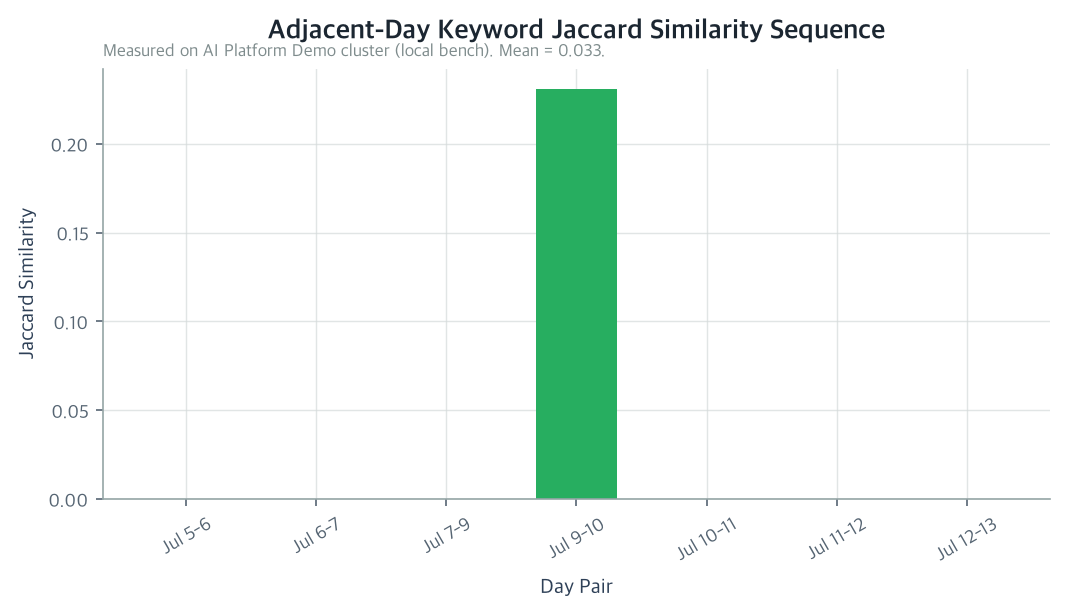 This figure plots the sequence of keyword Jaccard similarity between adjacent day pairs. The single nonzero spike, between 07-09 and 07-10, reflects an openly continued multi-day research thread rather than concealed duplication (mean 0.033).
There was also a trap in how to average the warning counts produced during the review stage. Averaging across all eight days, counting the four days when review never ran as zero warnings, gives 1.25. Averaging only over the four days when review actually ran gives 10/4=2.5. The authors point out that these two numbers answer different questions, and presenting only one of them quietly hides the choice of denominator. All four completed reviews had zero blocking issues, which is a reassuring signal, but the authors also note that with only four completed reviews, there is no way to distinguish a genuinely clean pipeline from an overly lenient reviewer. Because the final approval gate is itself an LLM judgment, the authors propose that this judging capability should not be validated through self-report but through periodic seeded-defect tests, deliberately inserting known flaws such as fake citations or fabricated figures and checking whether the review stage actually catches them.
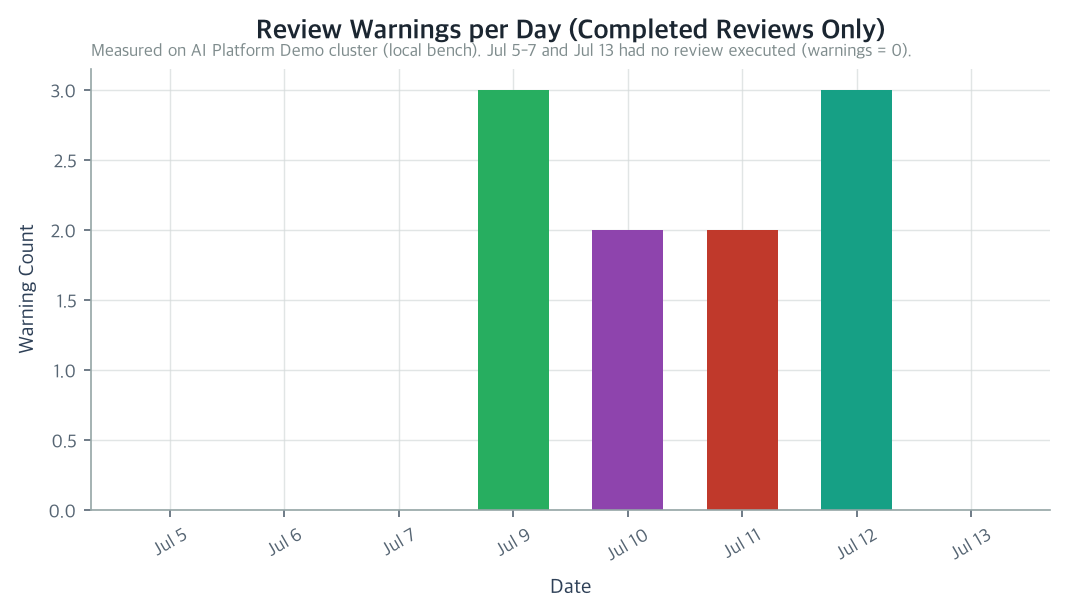 Daily warning counts from the four completed reviews. 07-05 through 07-07 and 07-13 show zero warnings because review never ran on those days. The average over completed reviews only is 2.5; the average over all eight days is 1.25, illustrating how the result depends on which denominator is chosen.
Bringing these observations together, the paper proposes a set of six minimal guardrails. First, a rolling multi-day novelty and duplication check tuned to permit openly continued multi-day research threads while still blocking concealed duplicates. Second, a blocking citation and data-integrity verification stage that every reference must pass before it can be added to the reference list. Third, language purity logging tagged with which stage and which artifact was checked, so that final-output violations are not conflated with upstream metadata written in the operator’s working language. Fourth, a habit of periodically and independently recomputing composite dashboard metrics from the raw logs. Fifth, a procedure for periodically adversarially testing the review and judging stage itself using seeded defects. Sixth, explicit logging of missing telemetry days, so that a missing day is never silently mistaken for a normal run. Each of these six responds directly to a specific failure or near-failure the paper actually observed, rather than reciting generic best practices.
Contributions Across Company, Society, and Science
The paper distinguishes contributions at three levels. At the organizational and industry level, the authors use the empirical audit of their own nightly-paper-factory pipeline, its topic duplication rate, domain skew, and verification gate pass rate, to directly improve their pipeline’s design. Because this is an audit of a system that actually runs every night rather than a hypothetical one, findings can feed directly into the next deployment. At the societal level, as fully autonomous AI research-generation systems spread more broadly across academia, the paper offers guidance for designing reproducibility and research-integrity guardrails, aiming to lower the risk that unattended systems quietly erode trust. At the scientific level, the paper offers a systematic methodology and set of metrics for auditing the reliability and diversity of LLM-agent-based autonomous scholarly production pipelines using real operational data, which sets it apart from generic agent reliability benchmarks or paper content quality benchmarks. The study explicitly places itself in a lineage that continues a qualitative case study the same organization previously published on a skill-routing harness recovery loop, while upgrading the methodology itself from a narrative case study to a quantified audit framework.
Limitations
The authors list this study’s limitations in detail themselves. The most fundamental is that it is a single-organization, single-pipeline case study, so the figures presented here describe only this one pipeline and make no claim of external generalization to autonomous research pipelines in general. The sample size is also just eight days, splitting into an extremely small three-day-before and four-day-after comparison (with one of those days itself missing), and every before/after contrast in Section 5 is presented as a descriptive contrast rather than a statistical hypothesis test. The five-stage pipeline model itself was inferred backward by the authors from the observed completion rates (0.6, 1.0, 0.2) rather than confirmed as an internal specification, so if the actual number of stages differs, the interpretation of completion rate would also change. What exactly the language purity flag checks could not ultimately be determined from the given log schema alone, which leaves the eighth-day reversal unexplained. The keyword-level diversity metric is only a weak proxy for deeper semantic diversity, and the entropy estimate itself is based on a small vocabulary set. The reliability of the review and judging stage itself was not independently audited in this study, only its pass/fail outcomes were observed, meaning the seeded-defect test the authors themselves propose remains future work. Finally, the record for the eighth day, the very day this paper was being written, was a non-independent, in-progress data point, and the authors do not hide the recursive situation this creates, in which the system being measured was itself generating the measurement.
Paper detail page: https://huggingface.co/datasets/thaki-AI/daily-paper-2026-07-13-autonomous-research-pipeline-reliability